
Community Trust Is Critical Infrastructure
Data center site selection is no longer just about power, land, water, and fiber. Community acceptance is becoming a critical part of project risk and a stronger path to long-term infrastructure value.
The Shoe Fits Strategic Advisors & Investments LLC · Connectivity. Strategy. Execution. Value.
Data centers are critical infrastructure. But critical infrastructure still has to earn community trust.
For years, data center site selection was often framed around four major questions:
Is there power?
Is there land?
Is there water?
Is there fiber?
Those questions still matter. In fact, they matter more than ever.
But they are no longer enough.
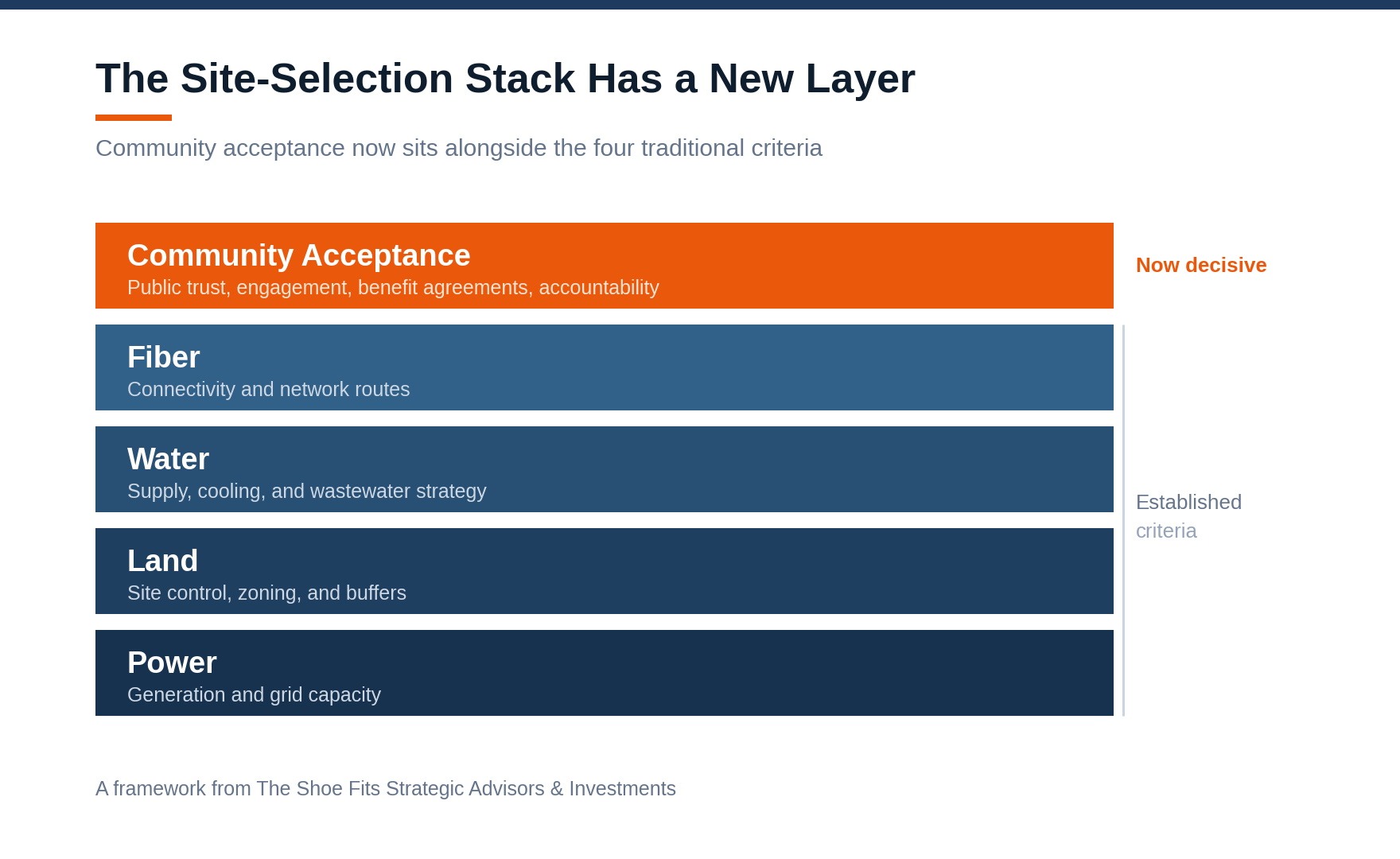
The four questions that traditionally drove site selection are now the base of a taller stack — with community acceptance sitting on top as the layer that increasingly decides whether a project gets built.
Across the country, communities are paying closer attention to data center development. Residents, local officials, utilities, school boards, economic development groups, and neighboring property owners are asking more detailed questions about what these projects mean for their communities. They want to understand the impact on water resources, power availability, utility costs, noise, land use, tax base, employment, traffic, emergency response, and long-term quality of life.
That does not mean communities are anti-growth.
It means they are demanding a more complete conversation.
Data centers are not small projects. They are major infrastructure assets. They support cloud services, artificial intelligence, enterprise connectivity, public-sector technology, financial systems, healthcare platforms, education tools, emergency communications, and the broader digital economy.
They also create real local value when planned well.
Data Centers Create Real Local Value
Loudoun County, Virginia is one of the clearest examples. The county says it is home to one of the largest concentrations of data centers in the world and that the industry has helped diversify the local economy, bring new jobs and revenue streams, and keep real property tax rates relatively low. Loudoun County also reports that for every $1 in services it provides to data centers, the county receives $26 in tax revenue.
I lived that reality firsthand in Lansdowne, a beautiful community between Ashburn and Leesburg, Virginia. It sits in a county constantly balancing two identities: proud, historic communities, farms, vineyards, and towns stretching west toward the foothills of the Appalachian Mountains, and the largest cluster of digital infrastructure in the world growing to the east.
That tension is important to understand.
For some residents, data centers are an abstract technology topic. For others, they are buildings, roads, substations, transmission corridors, fiber routes, work zones, school investments, tax revenue, construction noise, and traffic patterns that affect daily life.
My perspective comes from both sides.
I have lived in neighborhoods directly impacted by data center growth. I have heard the constant construction around my community at times. I have seen local roads disrupted when semis took the wrong turn. I have experienced major water disruption during utility hits caused by adjacent or required construction.
I have also seen the upside: strong tax-base generation, STEM-focused education, demand for skilled trades, high-quality technical career pathways, local contracting opportunities, and long-term economic growth when the revenue is managed well.
That is why this conversation cannot be one-sided.
Google’s Loudoun County impact report, prepared with Deloitte, reported that from 2017 to 2022 its Loudoun County data center investments contributed about $1.1 billion annually to local GDP, supported about 3,500 direct, indirect, and induced jobs, and included about 400 direct jobs in 2022.
AWS has reported that in Virginia it has invested more than $91.5 billion, supported 20,700 full-time-equivalent jobs annually, generated more than $30 billion in GDP in the Commonwealth, and paid $542.9 million in property taxes and fees in Virginia in 2024 alone.
I also saw how those investments can show up beyond the facility fence line.
During my time with AWS, I volunteered at Northern Virginia Community College to help with a certified fiber optic training program. AWS describes its Fiber Optic Fusion Splicing Certificate Course as a no-cost program that teaches students how to install and repair fiber optics through lectures and hands-on lessons, while also connecting students with local employers. Loudoun County Economic Development also described the AWS/NOVA/Sumitomo Electric Lightwave course as a free training opportunity with limited seats and employer networking.
That kind of program matters. It can create a real path into the skilled trades and telecom infrastructure work that supports data centers, broadband, utilities, and cloud infrastructure. In my experience, those career pathways can start in the $20-plus hourly range and grow into the $40-plus hourly range for skilled, productive, quality-focused workers, with additional upside where production and quality bonuses are available.
I also had the opportunity to volunteer with AWS efforts to pack backpacks filled with school supplies donated by fellow employees and the company for students who needed extra support. Amazon’s Northern Virginia “Right Now Needs” initiative included backpacks filled with essential school supplies for qualifying elementary and middle schools, in partnership with Communities In Schools of Northern Virginia.
I had the opportunity to apply for Amazon-funded grants and donations for my own children’s schools. As a father of five, that matters to me. These were not just corporate programs on a slide deck. They were real examples of infrastructure development touching classrooms, families, workforce training, and community support.
But Benefits Do Not Erase the Concerns
The same project that creates tax revenue can also create questions about water, wastewater, power delivery, transmission routes, noise, visual impact, land use, emergency response, workforce housing, incentives, and long-term accountability.
Communities are not just asking, “Will this project create revenue?”
They are asking, “What will this project require from us, and how will we know the commitments are being kept?”
That is where community trust becomes part of the project itself.
Recent public sentiment shows how important this has become. Gallup found that seven in ten Americans oppose the construction of an AI data center in their local area, including 48% who are strongly opposed.
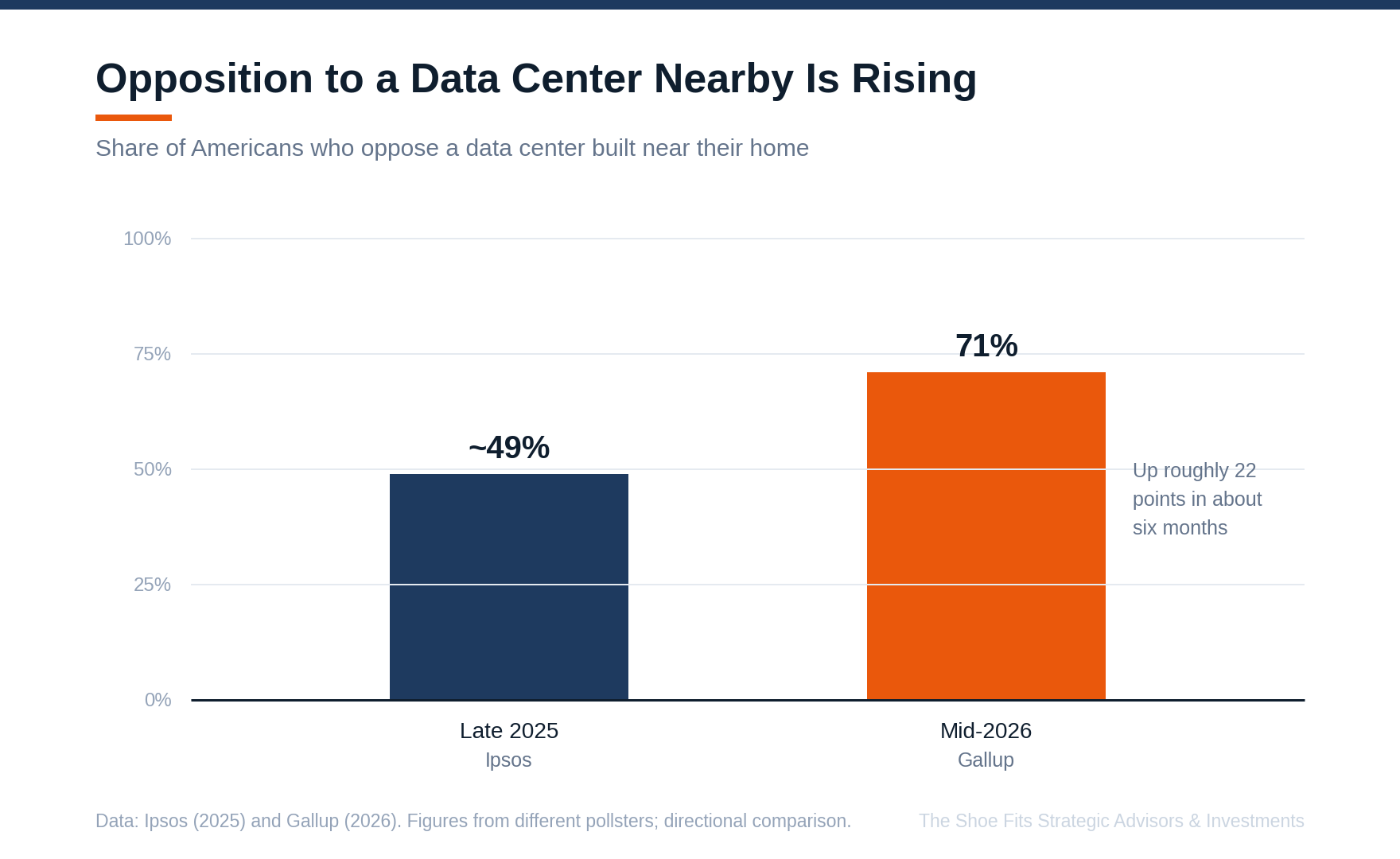
Gallup’s mid-2026 reading (71% opposed) caps a sharp climb in under a year — a signal of how much closer communities are now watching, not blanket rejection.
The Harvard Gazette has also covered the rise in community pushback, pointing to concerns around electricity rates, water use, tax incentives, and whether data centers bring meaningful local economic development and jobs.
Industry coverage has connected that opposition directly to project risk. Data Center Knowledge reported that a Data Center Watch study found $64 billion worth of U.S. data center projects had been blocked or delayed since 2023, including $18 billion canceled and $46 billion delayed.
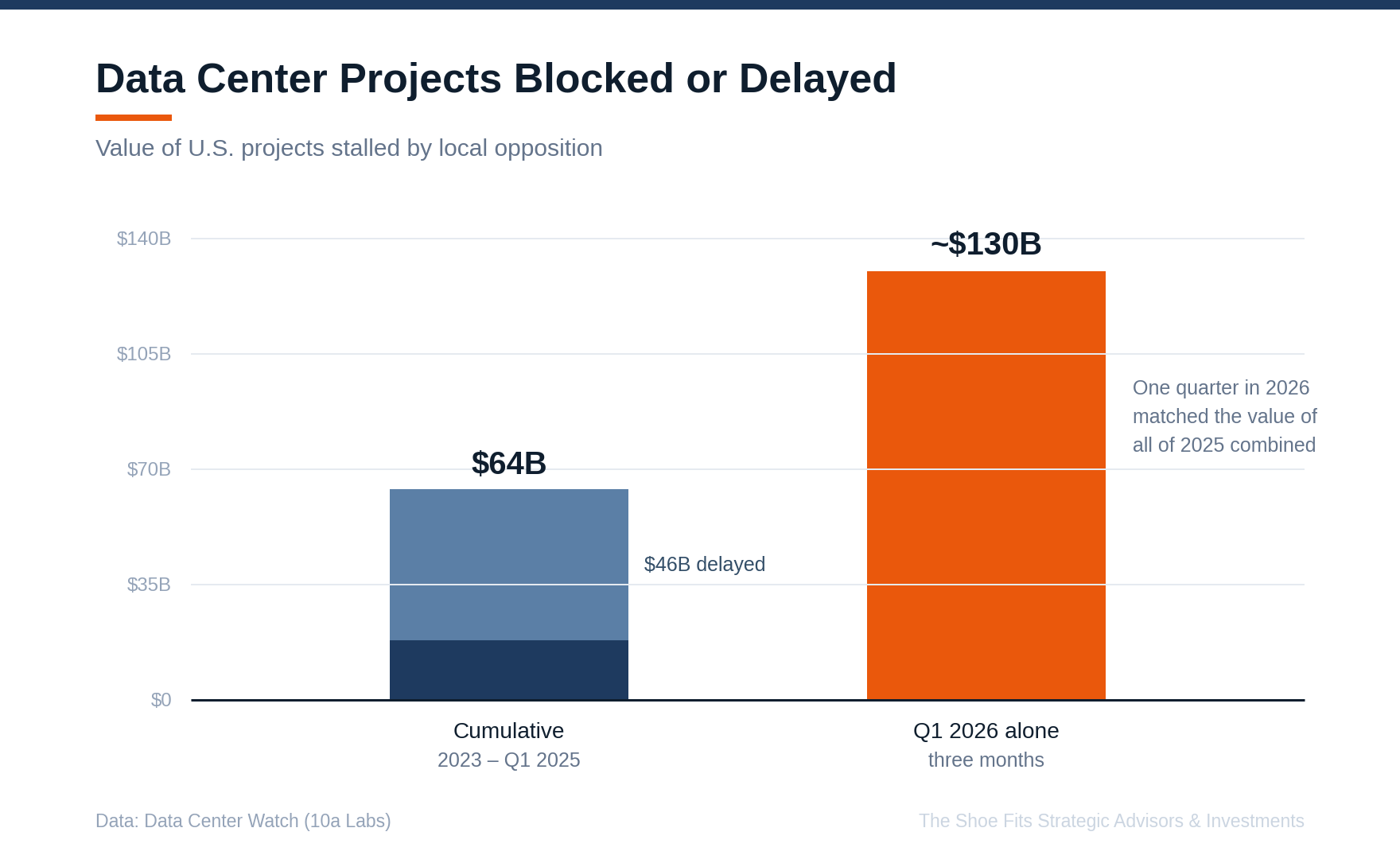
The $64B cited above is a two-year cumulative figure. A single quarter of 2026 then stalled roughly the same value as all of 2025 combined — a structural shift, not a cyclical spike.
The lesson is clear:
Community acceptance is no longer a soft issue.
It is project risk.
Community Acceptance Is Now Project Risk
That risk can appear during zoning hearings, utility negotiations, permitting reviews, environmental discussions, media coverage, public comment periods, or local elections.
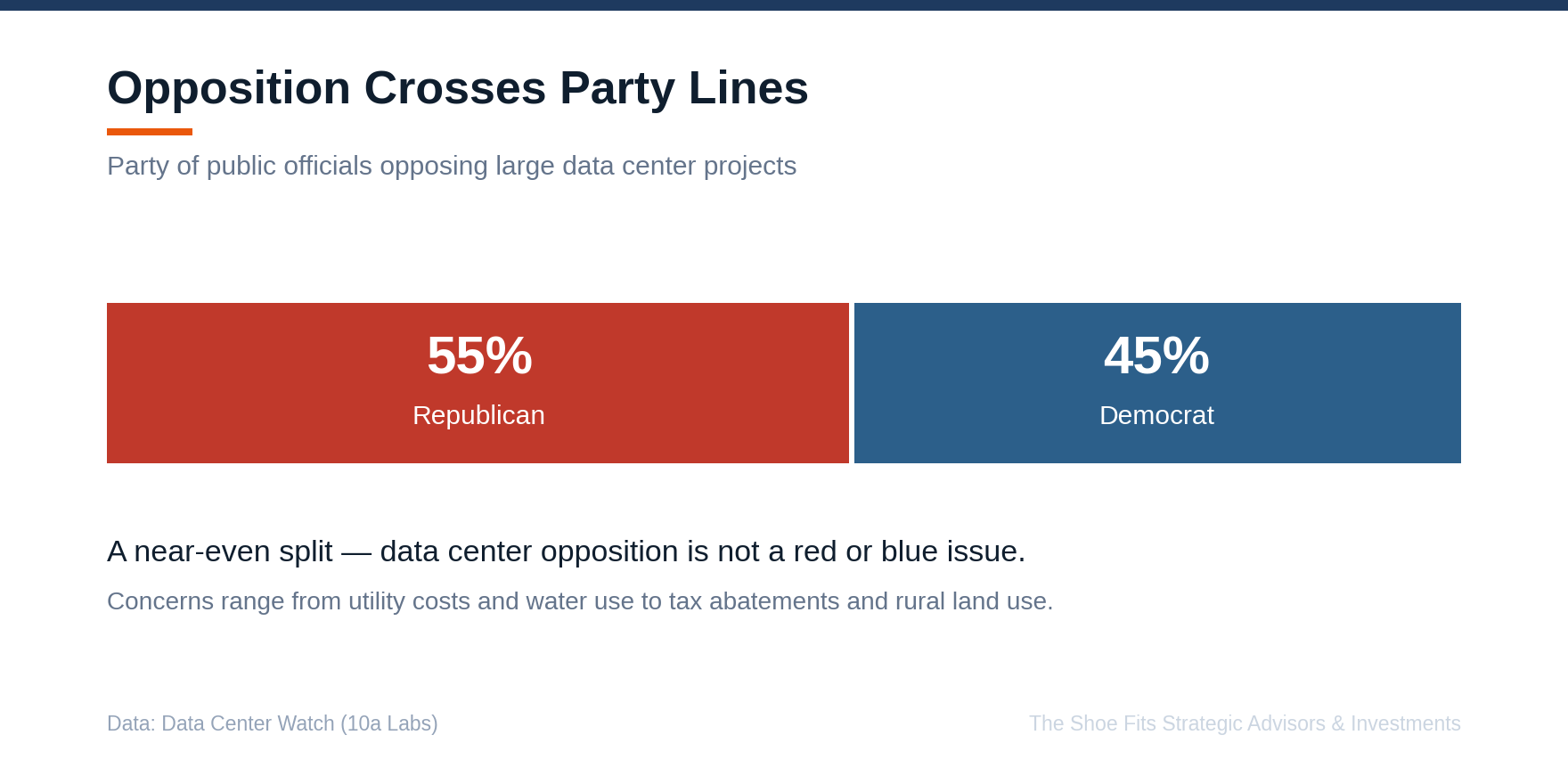
Because opposition is bipartisan, it rarely resolves through a single political channel — and it can surface at almost any stage of a project.
It can also appear later, after a project is approved, when operational impacts begin to affect nearby residents.
Strong projects do not wait until opposition forms to explain themselves.
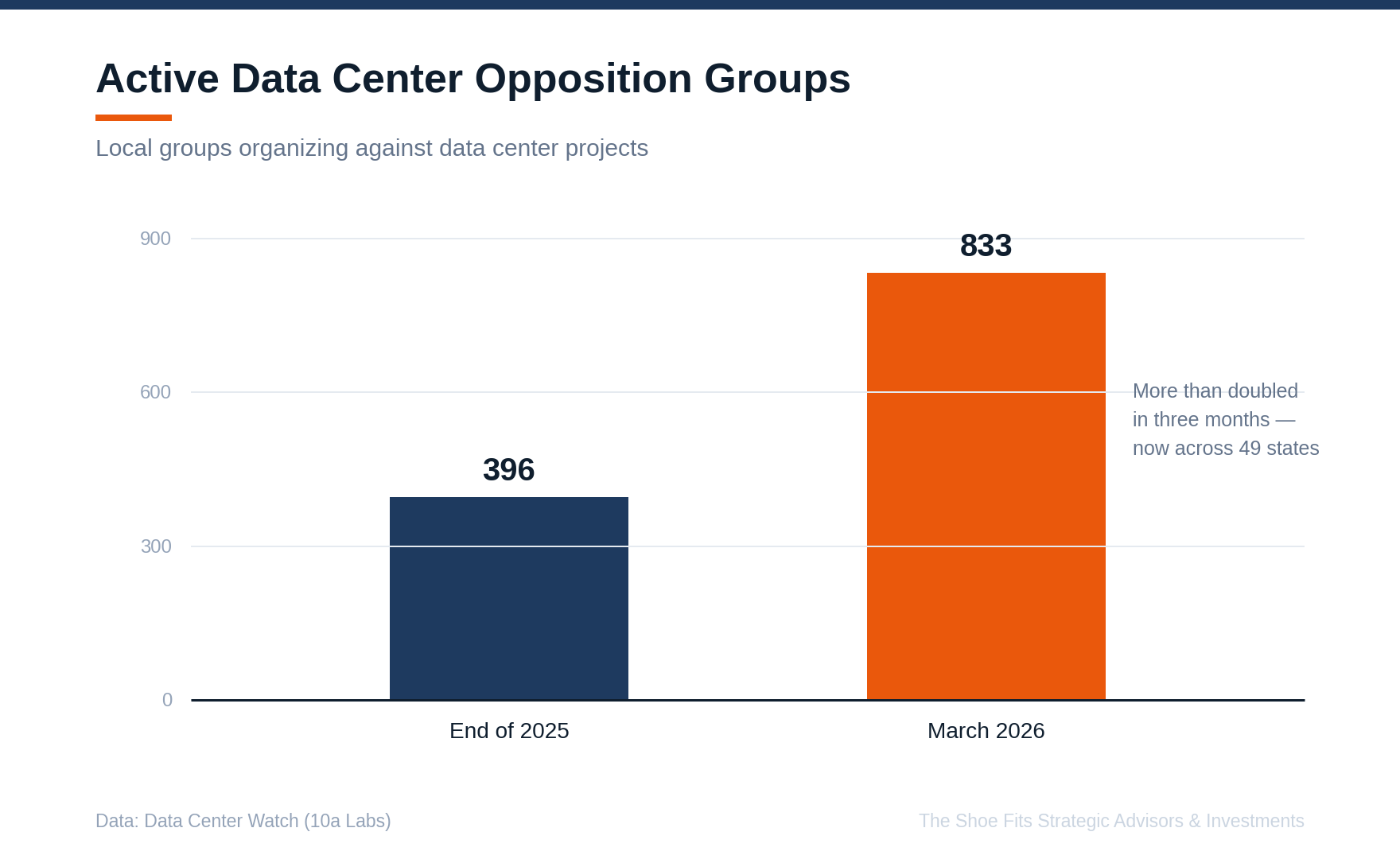
Organized opposition is scaling faster than most project timelines — which is why waiting for it to appear is rarely a workable strategy.
They identify concerns early and design around them where possible.
That starts with listening.
A better community engagement process does not simply ask:
“How do we get this approved?”
It asks:
What does this community already need?
Where are the infrastructure constraints?
What concerns are likely to be legitimate?
What can be engineered, mitigated, measured, or negotiated?
What commitments can the project team realistically keep?
How will the public know whether those commitments are being met?
Those questions move the conversation from public relations to project planning.
Community Concerns Can Become Design Inputs
There are already examples of developers and operators working directly with communities or local systems to address concerns.
Water is one of the clearest examples. AWS has announced an expansion of recycled water use for data center cooling from 24 to more than 120 U.S. locations, saying the effort is expected to preserve more than 530 million gallons of drinking water annually. AWS describes the model as working with utilities to collect treated wastewater, clean it to appropriate standards, and reuse it for cooling instead of using potable water.
Noise is another example. Compass Datacenters and Vertiv publicly documented a sound mitigation effort near Compass’s Leesburg, Virginia campus after neighbors raised concerns. Their teams identified that an elevated pitch was tied to turbulent airflow around a fan support bracket. By re-engineering the fan mounts and making a software adjustment, Compass reported a 20% reduction in sound pressure at lower frequencies and no tonality found at neighborhood sites.
Community commitments are becoming more formal as well. In Lancaster, Pennsylvania, the Lancaster AI Hub Community Benefits Agreement includes specific commitments around noise testing, low-noise chiller systems, daytime generator testing, clean-energy usage, water caps, closed-loop cooling, wastewater limits, landscaping buffers, dark-sky lighting, emergency response planning, public reporting, complaint response, local hiring efforts, and financial contributions. The agreement summary says water use is capped at 20,000 gallons per day per campus and that closed-loop cooling must minimize municipal water use.
The Federation of American Scientists also summarized the Lancaster agreement as a legally binding Community Benefits Agreement that secured $20 million in community contributions, including a 20,000-gallon-per-day municipal water cap per campus, clean-energy requirements, noise limits, and public records transparency.
These examples matter because they show that community concerns are not always obstacles.
Sometimes they are design inputs.
Water strategy can be engineered.
Noise can be modeled and mitigated.
Traffic can be planned.
Buffers can be designed.
Workforce commitments can be measured.
Emergency response can be coordinated.
Community benefits can be written down, funded, and reported.
During my time in the hyperscale space, these concerns were part of the real work of evaluating and designing sites.
I have seen hundreds of thousands of dollars spent on sound studies and mitigation. I remember counterparts delaying a site in Prince William County for months to complete additional sound studies and make micro-adjustments to reduce the impact on one street in a nearby neighborhood.
My own team delayed a fiber build for nine months to avoid construction noise during the nearby nesting season of a bald eagle.
I have seen temporary roads built to avoid traffic disruption in local communities. I have also been part of easement discussions where parks and nature preserves became part of the broader project solution.
That is what responsible infrastructure planning looks like.
Transparency Matters
That does not mean every project will be accepted.
It also does not mean every proposed benefit should be taken at face value.
Job creation, in particular, needs to be discussed honestly. Data centers can create significant construction activity and high-quality operational roles, but they are often less labor-intensive than other major industrial developments.
Brookings notes that large data center projects often promise dozens to a few hundred permanent workers while construction jobs are temporary. At the same time, Brookings found that counties receiving their first large data center saw total private employment rise by 4% to 5% over five to six years, with construction employment rising 11%, information-sector employment rising 22%, and wages rising 3% to 4%.
That is exactly why transparency matters.
Communities deserve to know what kind of jobs are being counted: construction jobs, full-time operational jobs, vendor jobs, indirect supplier jobs, or induced jobs from local spending.
They also deserve to know what revenue is recurring, what revenue is abated, what infrastructure costs are public or private, and what commitments survive after the ribbon cutting.
From Data Center Alley to Northeast Louisiana
That same tension is now visible in Louisiana.
Meta’s Richland Parish project represents a new chapter for Northeast Louisiana and is especially relevant to our region. Louisiana Economic Development reported that the project is expected to create 500 or more direct jobs, more than 1,000 indirect jobs, and 5,000 construction workers at peak on a 2,250-acre site between Rayville and Delhi, about 30 miles east of Monroe.
Meta has also reported that, within the first year of the Richland Parish project, it had contracted more than $875 million with Louisiana businesses, expanded local infrastructure investment to more than $300 million for roads, water, and wastewater systems, and committed $300,000 to support parks and local landmark restoration projects in Rayville, Delhi, and Mangham.
My move to Louisiana was directly adjacent to the Richland Parish data center development and BEAD fiber-to-the-home deployments. I joined a company growing in the utility connectivity space that specialized in FTTH deployment. I now live in a community and region seeing historic investment in the data center space, and I have already seen local firms hiring new employees and new local businesses forming to support the work.
That experience helped bring me back to my core passion:
Connectivity for all stakeholders.
Evaluate the Fit Before the Risk
For developers and investors, community trust can influence schedule, entitlement risk, legal exposure, utility coordination, political support, and long-term operating relationships.
For communities, it can influence whether the project creates lasting value or simply adds pressure to existing systems.
The best data center projects will increasingly be evaluated by more than technical feasibility.
They will be evaluated by fit.
Fit includes power, land, water, and fiber.
But it also includes public acceptance, utility alignment, environmental planning, noise design, water strategy, economic benefit, local workforce planning, emergency response, transparency, and accountability.
At The Shoe Fits Strategic Advisors and Investments LLC, we believe the next phase of digital infrastructure will require more than site control and utility availability. It will require a broader understanding of how infrastructure interacts with communities.
Data centers are critical infrastructure. But critical infrastructure still has to earn community trust.
Because approval matters.
But acceptance matters too.
Connectivity. Strategy. Execution. Value.
Sources & Further Reading
Public opinion & project risk
“Americans Oppose AI Data Centers in Their Area” — Gallup (May 2026)
news.gallup.com/poll/709772/americans-oppose-data-centers-area.aspx
The March 2026 survey finding roughly seven in ten Americans oppose a data center in their local area, with 48% strongly opposed.
“Why are communities pushing back against data centers?” — Harvard Gazette (April 2026)
news.harvard.edu/gazette/story/2026/04/why-are-communities-pushing-back-against-data-centers/
A policy expert argues concerns over electricity rates, water use, and tax incentives are legitimate, and that the pushback crosses party lines.
“Local Opposition Hinders More Data Center Construction Projects” — Data Center Knowledge (2026)
datacenterknowledge.com/regulations/local-opposition-hinders-more-data-center-construction-projects
Reports the Data Center Watch finding that $64 billion in U.S. projects were blocked or delayed since 2023 — $18 billion cancelled, $46 billion delayed.
Data Center Watch (10a Labs) — opposition & project-disruption report
The underlying tracker cataloguing blocked and delayed projects, the growth of opposition groups, and the bipartisan makeup of local resistance.
Economic impact & jobs
“New evidence on data center employment effects” — Brookings (May 2026)
brookings.edu/articles/new-evidence-on-data-center-employment-effects/
County-level research finding data centers do lift local employment (4–5% over five to six years) while cautioning that permanent headcounts stay small.
Also referenced above
Primary and regional sources cited in this piece — link to each organization’s official page for current figures: Loudoun County Economic Development ($26-to-$1 tax return; AWS/NOVA/Sumitomo fiber optic course); Google’s Loudoun County Economic Impact Report (with Deloitte); AWS Virginia economic-impact and recycled-water announcements; Amazon “Right Now Needs” with Communities In Schools of Northern Virginia; Compass Datacenters and Vertiv sound-mitigation documentation; the Lancaster AI Hub Community Benefits Agreement and the Federation of American Scientists summary; and Louisiana Economic Development and Meta on the Richland Parish project.