
The Power Behind the Projects and the Heat They Leave Behind
Every data center buys its energy once and rejects it once. Episode 3 follows both halves of that ledger: who builds the generation, who carries the risk and why the heat coming off the racks does not have to be waste.
The Shoe Fits Strategic Advisors & Investments LLC · Connectivity. Strategy. Execution. Value.
Every megawatt a data center buys ends up as heat. Strong projects plan for both ends of that transaction.
In Part 1, I made the case that community acceptance has become part of the infrastructure stack. In Part 2, I argued that water strategy is a site-selection gate, not a sustainability statement.
This episode is about the biggest number on the whole project: power.
And it is about a second number that almost nobody in the public conversation connects to the first one, even though physics connects them completely.
Servers consume electricity. That electricity becomes heat. All of it. Every megawatt purchased at the meter leaves the building as thermal energy that the facility must remove continuously to protect equipment, maintain reliability, and support uptime.
So a data center's energy story is really one transaction with two ends. On the front end: who builds the generation, who signs the contracts, and who carries the risk. On the back end: what happens to all that energy once it has done its work.
Communities are learning to ask hard questions about the front end. The strongest projects are starting to answer a better question about the back end:
Can that heat be used for something?
Let's take both ends in order. Because they belong in the same conversation — and in the same site-selection process.
The Power Question Is Really a Risk Question
Start with the national picture, because it explains why your neighbors are suddenly reading utility dockets.
In PJM, the grid region covering Data Center Alley and much of the mid-Atlantic, capacity prices have surged to record levels in back-to-back auctions, and reporting and market analysis have attributed the large majority of that increase to data center demand growth. Consumer advocates across PJM states are now publicly connecting those auction results to household bills. The Institute for Energy Economics and Financial Analysis found that projected data center growth helped push PJM capacity prices up by roughly a factor of ten in a single auction cycle.
I lived in that grid region. The people I went to church with, coached sports with, and shared a fence line with are the ratepayers in those headlines.
Here is the honest framing: the question communities are asking is not really "is there enough power?" Utilities and developers will find the megawatts. The question is who pays for them, and who is left holding the asset if the load does not show up — or does not stay.
That is a risk-allocation question. It has answers. But only if somebody asks it out loud, early, with the numbers on the table.
Who Builds the Generation Now
A few years ago, the answer was simple: the utility builds it, everybody shares it. That model is being stretched into new shapes, and each shape allocates risk differently.
The utility builds, the customer contracts. This is the Louisiana model, and I will come back to it, because it is happening thirty miles from my house.
The customer contracts for a power plant's entire output. Microsoft signed a 20-year agreement for 835 megawatts from the retired Three Mile Island Unit 1 — now being restored as the Crane Clean Energy Center — a restart that has since drawn a $1 billion federal loan guarantee. Amazon's arrangement with Talen Energy at the Susquehanna nuclear plant started as a behind-the-meter deal, drew a FERC rejection when it sought to expand, and was restructured in 2025 as a grid-connected power purchase agreement reported at up to 1,920 megawatts running into the early 2040s.
Read those two stories carefully, because they are the same lesson from opposite directions. A data center customer buying a nuclear plant's output for twenty years is assuming risk — committing its own balance sheet to generation instead of leaning on ratepayers. And the FERC fight over Susquehanna was, at its core, an argument about whether a behind-the-meter arrangement was quietly shifting transmission and reliability costs onto everyone else. The structure is the substance.
The developer brings its own generation. Onsite turbines, fuel cells, batteries, and eventually small modular reactors. This model concentrates risk on the developer instead of on ratepayers, and it moves fastest of the three, because it does not wait in an interconnection queue.
It is also, as of this month, the most contested.
None of these models is automatically good or bad for a community. What matters is the allocation: term length versus asset life, who backstops the debt, what happens on early exit, and what is enforceable versus what is a press release.
If that sounds familiar, it should. It is the permitted-versus-promised lesson from Episode 2, wearing a hard hat instead of a rain jacket.
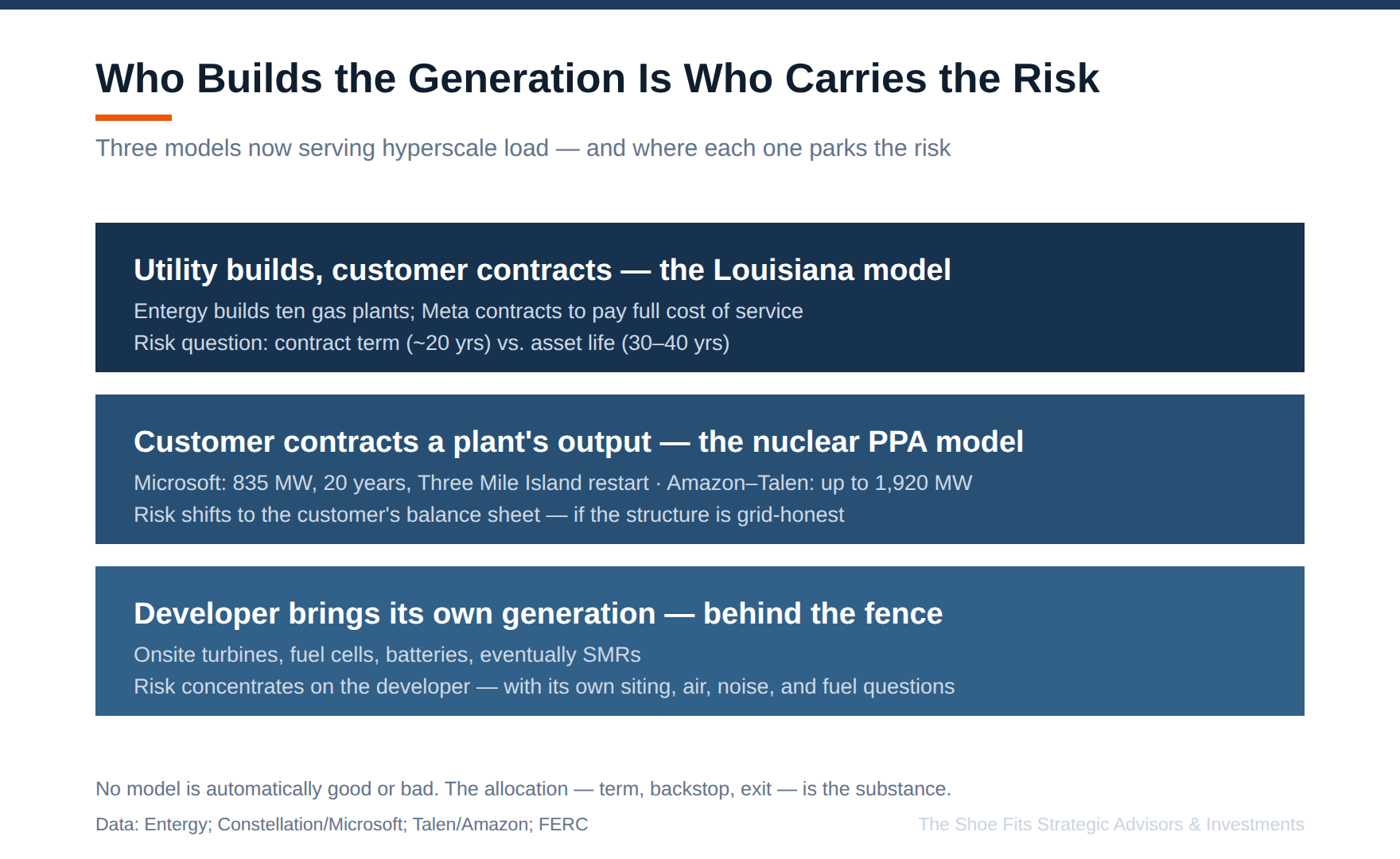
Who builds the generation is really a question of who carries the risk: the utility's ratepayers, the customer's balance sheet, or the developer's project financing.
The Third Model Just Got Its Test Case
That third model, build your own power, skip the grid, is the one moving fastest right now. It is also the one that just landed in court.
In late July 2026, the Environmental Integrity Project, the Sierra Club, and Public Citizen filed a notice of intent to sue Vantage Data Centers and its power partner VoltaGrid over two off-grid campuses outside San Antonio, on Omicron Drive and Rogers Road, sited in and near residential areas. Between them, the projects are reported to carry roughly 423 megawatts of gas-fired generation plus about 151 diesel backup generators totaling some 454 megawatts. Enough generation, as one account framed it, to power a city the size of Richmond, Virginia with no utility and no grid in the middle.
The legal theory matters more than the venue, because it will travel. The groups allege that the companies permitted the power plants and the data centers they serve as separate facilities, keeping each below the Clean Air Act's “major source” threshold and qualifying instead for minor-source permits, the lighter category, which does not carry the same pollution-control requirements, emission limits, or public review. The pollutants named in the notice include nitrogen dioxide, carbon dioxide, and formaldehyde. The groups gave a 60-day window before heading to federal court.
Now the other column, because it is real too. A notice of intent to sue is an allegation, not a finding. Vantage has said it takes its environmental responsibilities seriously, is committed to operating in compliance with all applicable laws, and has worked closely with the appropriate regulatory agencies. The Texas Commission on Environmental Quality says it issues only permits that comply with state and federal rules. And whether generation built to serve a single customer on an adjacent parcel is one source or two is a genuine question of Clean Air Act interpretation being tested now precisely because the fact pattern is new at this scale.
Texas is not the only place this is being measured. In March 2026, a study commissioned by the Piedmont Environmental Council and performed by EmPower Analytics Group, using EPA's COBRA model, estimated that roughly 135 megawatts of onsite generation at a Vantage site in Loudoun County, Virginia, eight gas turbines and 51 diesel generators, could cause $53 million to $99 million a year in health damages from fine particulate matter, along with 3.4 to 6.5 premature deaths annually, from roughly 95 tons of nitrogen oxides and more than 56 tons of soot a year. Read those numbers for exactly what they are: modeled output, commissioned by a party opposed to the project, not a measurement at a fence line. But notice why the modeling had to be commissioned at all. The permits issued without a process that would have put the question in front of the public first.
The Loudoun story did not end with the modeling, and what came after is the reason I am spending this much of a power-and-heat episode on paperwork.
Internal emails obtained by E&E News through public records requests, and reported on July 25, 2026, show that when the Piedmont analysis published on March 4, the director of Virginia's Department of Environmental Quality forwarded it to seven members of his staff in under five minutes, asking them to make time to produce “a defensible critique that will stand the test of public and critical review.” One staffer responded that the agency was not qualified to do that review. DEQ released its counterreport in late April.
Read that sequence carefully, because the trap here is reading it too hard. There is nothing improper about a regulator moving fast on a study that criticizes a permit it issued, and nothing improper about disagreeing with the study. DEQ's substantive position, that modeled concentrations came in under EPA's ambient air quality standards, is the position a permitting agency is supposed to take, because compliance with the standard is the thing it is charged with administering. The agency has said it did not coordinate with outside parties. And Piedmont's own reply, published April 29, named the mismatch more precisely than any accusation would have: “DEQ asked a compliance question. The PEC report asked a health question.” Both halves of that sentence describe people doing their jobs. They were simply not answering the same question, and only one of those questions is the one a family living a quarter mile away is actually asking.
But the operative word in the director's email is defensible, and it was chosen the day after publication, before anyone on that staff had assessed whether the analysis was right. The instruction was not “tell me whether this is correct.” It was closer to “build me something that will hold up.” Those are different assignments, and a community reading them side by side will know which one it got. Nor does it help that the outside experts who weighed in, including a former EPA air quality official, made a point regulators have understood for years: fine particulate matter causes measurable harm below the level EPA calls attainment, which is why the World Health Organization's guideline sits near half of it. Meets the standard and is safe are not the same sentence, and the public has gotten better at hearing the difference.
Here is the developer's version of this, and it has nothing to do with Virginia. If the only party publicly defending your air permit is the agency that issued it, you have already lost the argument you most needed to win. A regulator's credibility is not spent by being wrong. It is spent by appearing to have decided first and reasoned second and a project standing behind that regulator inherits the deficit whether it earned it or not. The projects that come through this decade intact will be the ones that put their modeling on the table before somebody had to file a records request to get it.
And the public side of that process is getting thinner, not thicker. In July 2026, EPA proposed eliminating the federal 30-day public notice requirement for this same class of minor-source air permits; the permits most data centers rely on for backup generators and small turbines.
Here is the part I want both developers and communities to sit with, because it is genuinely uncomfortable.
Onsite generation is the answer to the problem Louisiana's critics are raising. A developer who builds his own power does not put a 30-to-40-year plant on the ratepayers' books, does not need a fast-tracked docket, and does not leave a stranded-asset question for somebody else's grandchildren. It very nearly solves the ratepayer risk problem.
It solves it by moving the burden off the utility bill and into the air above the nearest neighborhood.
That is not an argument against building your own generation. In a lot of places it will be the right answer, and the ratepayer case for it is strong. It is an argument for treating the air permit with the same seriousness this industry has finally learned to bring to the water registration. Episode 2's lesson was that the permitted number and the promised number can both be true, and that trust dies in the gap between them. This is that lesson in a different medium: a minor-source permit and a major thermal source can describe the same building. The neighbors will notice which word the paperwork used.
There is one more thing worth saying plainly, and it belongs to the back half of this episode. All that onsite generation is a second thermal stream — turbine exhaust, at temperatures far above anything coming off a server rack. A project already fighting about what comes out of its stacks is a project with an obvious, underexamined question in front of it: what else could that heat be doing?
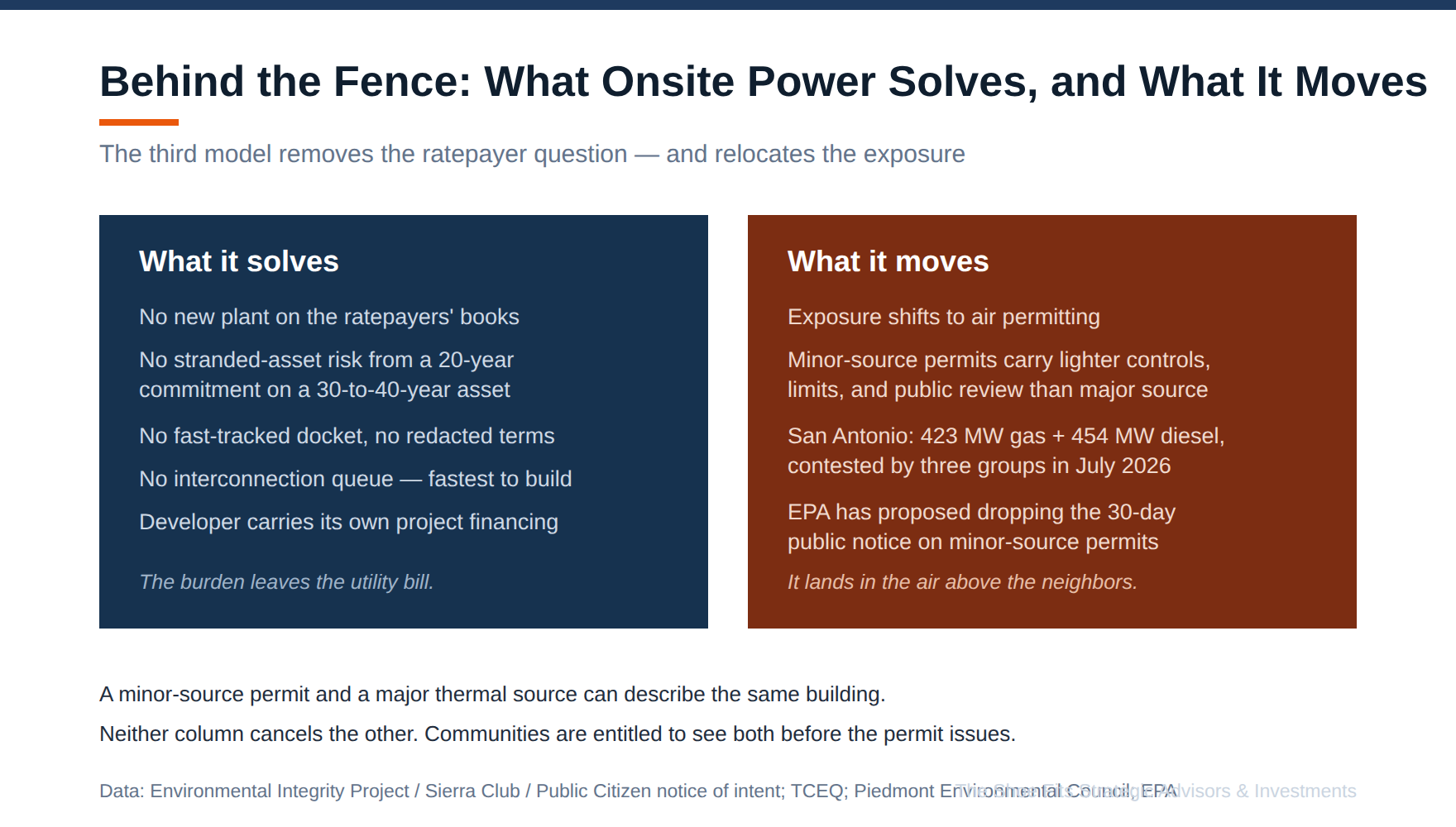
The tradeoff at the center of behind-the-fence power. Neither column cancels the other — and communities are entitled to see both before the permit is issued.
The 30% Question, Thirty Miles from My House
Episode 2 ended with a promise to talk about what a 30% jump in statewide electricity demand means for everyone who pays a bill. Here it is.
Meta's Richland Parish campus is expected to increase Entergy's electricity needs in Louisiana by roughly 30% statewide. To serve it, the Louisiana Public Service Commission approved an agreement for Entergy Louisiana to build three combined-cycle natural gas plants — two in Richland Parish targeted for late 2028, one at the existing Waterford site in St. Charles Parish targeted for the end of 2029 — along with new transmission and authorization to procure up to 1,500 megawatts of solar.
Then the project got bigger. In 2026, Entergy and Meta announced an expanded agreement — reported as the campus scaling toward 5 gigawatts — covering seven combined-cycle plants totaling more than 5,200 megawatts, roughly 240 miles of new 500 kV transmission, battery storage at three locations, nuclear uprates, and up to 2,500 megawatts of renewables. In April 2026, the Commission voted 4–1 to fast-track review of the seven new plants, with a final vote scheduled for November 18, 2026.
Now, the risk-allocation ledger — both sides of it, because both sides are real.
What the deal structure gets right. Meta is contracted to pay its full cost of service. Entergy says that structure will deliver roughly $2 billion in savings to other customers over 20 years — about $2.65 billion combined with earlier commitments — because Meta's payments help cover fixed costs, including storm and resilience investments, that existing customers would otherwise carry alone. Meta has layered on commitments including $120 million for The Power to Care and $140 million for energy efficiency for lower-income customers. Both companies have named the principle out loud: Meta's Ratepayer Protection Pledge, Entergy's Fair Share pledge. Naming the principle publicly matters, because it gives regulators and residents something to hold.
What the critics get right. The Alliance for Affordable Energy and the Union of Concerned Scientists have raised objections that deserve engagement rather than dismissal. The fast-track process removed the administrative law judge review and bypassed competitive bidding. Key contract terms sit behind non-disclosure agreements and redactions. Louisiana already generates roughly 75% of its electricity from natural gas, and these plants deepen that dependence at a moment when LNG exports are making gas prices more volatile. And there is a duration mismatch at the center of it: Meta's commitment runs about 20 years, while a combined-cycle plant is a 30-to-40-year asset. If the load leaves early, somebody owns the difference. The state has felt enough heat that the governor signed an executive order on ratepayer protection while defending the projects.
Both paragraphs are true at the same time. That is the point.
This is Episode 2's discipline applied to power: the right unit of analysis is the project and the process, not the company. A cost-of-service contract with named pledges and quantified customer benefits is a genuinely stronger structure than most communities get. And a fast-tracked review with redacted terms is a genuinely weaker process than a 30% jump in statewide demand deserves. The structure builds trust. The process spends it.
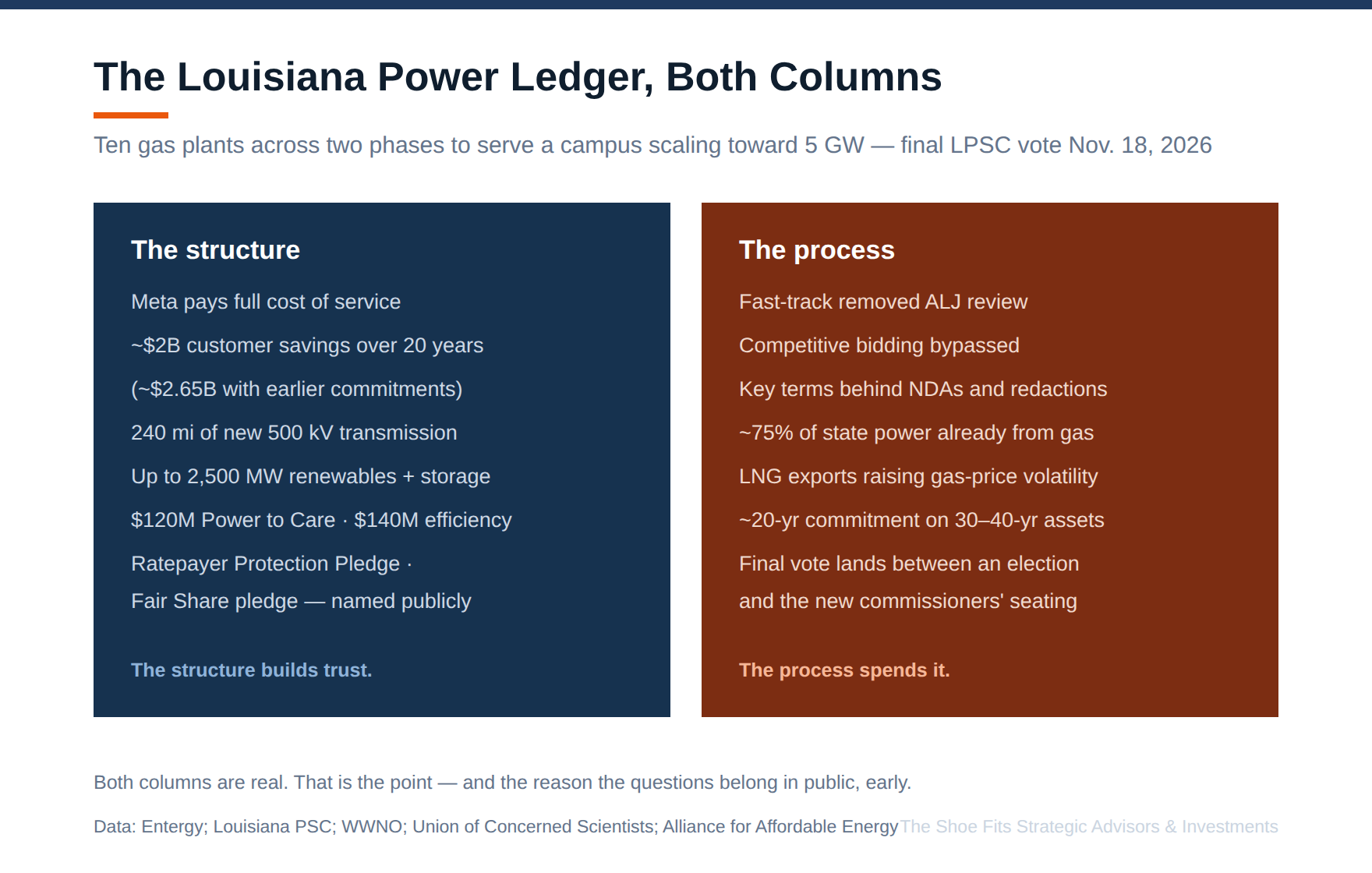
The Richland Parish power buildout, both columns: the contracted protections and customer benefits on one side, and the gas dependence, redactions, and duration mismatch on the other. Both columns are real.
For a community evaluating any project, the power questions to ask early are the same everywhere:
Who builds the generation, and who owns it?
What is the contract term, and what is the asset life?
What happens if the customer leaves, shrinks, or is acquired?
Is the customer paying full cost of service — and who verifies that?
What is disclosed, what is redacted, and why?
How much of the new fuel-price risk lands on existing ratepayers?
What do the pledges convert into: tariff language, or talking points?
And if any of the power is generated on site, a second set that communities have been slower to ask:
Is there onsite generation, and under what air permit — minor source or major source?
Were the generation and the data center permitted together, or as separate facilities?
Was there a public comment period? If not, what removed it?
What are the modeled emissions at the property line, and who verified them?
Is that modeling published, or would a neighbor have to file a records request to see it?
How many hours a year may the backup generators run, and is that limit enforceable?
Who monitors actual emissions once the site is operating, and is that data public?
These are the front end of the energy transaction. Now the part almost nobody connects.
Every Megawatt Ends Up as Heat
Here is the physics that should reframe the whole conversation.
The electricity a data center buys does not disappear into the cloud. Nearly all of it converts to heat inside the building — in the chips, the power systems, the racks. The facility must remove that heat continuously, every hour of every day, or the equipment fails. Traditionally, the engineering conversation has focused on how to reject that heat safely and efficiently: cooling towers, chillers, dry coolers, the water questions we covered in Episode 2.
But step back and look at what that means at today's scale.
A campus drawing multiple gigawatts is, functionally, one of the largest thermal sources in its region. The community just fought about — or welcomed, or negotiated — every one of those megawatts on the way in. And then the standard design throws essentially all of that energy away on the way out.
Communities are starting to ask a better question:
Can that heat be used for something?
In many cases, the answer may be yes. Not everywhere. Not automatically. Not without engineering, economics, and local infrastructure. But in the right conditions, waste heat can become part of a broader community benefit strategy — and part of the answer to the power question, because a project that returns energy to its neighbors is a different neighbor than one that only draws it.
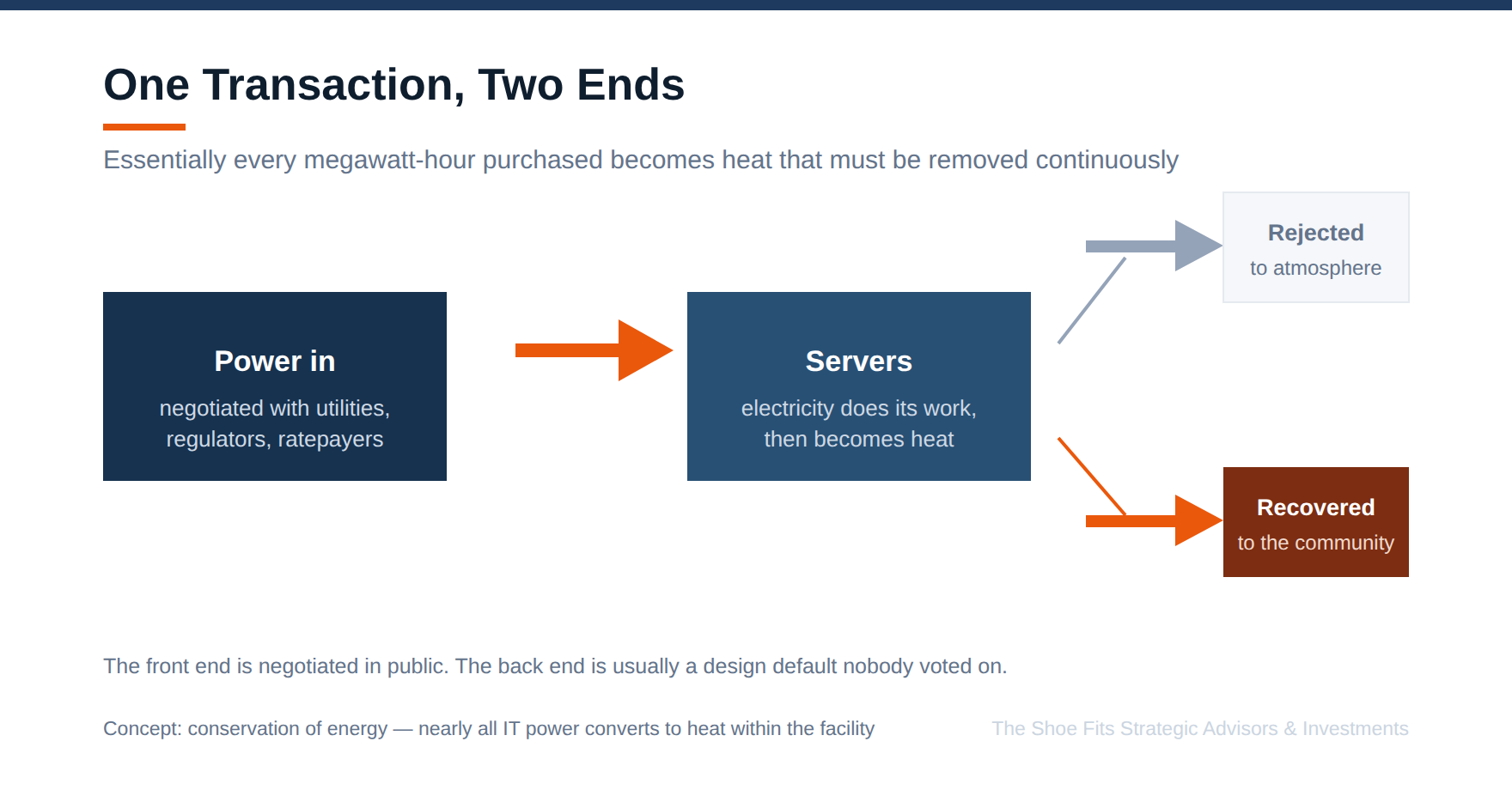
One transaction, two ends. The front end is negotiated with utilities and regulators. The back end is usually rejected to the atmosphere — and does not have to be.
Waste Heat Does Not Have to Be Waste
The idea is straightforward. Instead of simply rejecting heat into the environment, a data center transfers recoverable heat to a district heating system, nearby buildings, public facilities, greenhouses, industrial users, or other thermal loads. The most practical applications occur where there is an existing or planned district energy network, dense nearby heating demand, a favorable climate, and utility partners capable of operating the system.
Europe has become the leading test bed, and the examples are no longer pilots.
Odense, Denmark. Meta's data center feeds surplus heat through Denmark's largest heat-pump installation of its kind — about 45 megawatts of heat production, roughly 215,000 megawatt-hours recovered annually — into Fjernvarme Fyn's district network, warming more than 12,000 homes. Ammonia heat pumps lift the low-grade server heat to the 70–75°C the network needs. This system has been running since around 2020. It is not a rendering. It is a utility asset.
Høje-Taastrup, Denmark. Microsoft has described a project where surplus heat from a data center under construction is expected to warm around 6,000 local homes through a partnership with district heating organizations including VEKS.
Hamina, Finland. Google's first offsite heat recovery project will send recovered heat into the local network, where it is expected to represent about 80% of the annual heat demand of the district heating system, according to utility partner Haminan Energia.
Tallaght, Ireland. An Amazon data center supplies the Tallaght District Heating Scheme, operational since 2022 — warming South Dublin County Council buildings, the county library, and the TU Dublin Tallaght campus, with expansion planned to 133 affordable apartments and, over its lifetime, potentially thousands of homes.
These examples matter for one reason above all: they show that community benefit can be engineered into the project. It does not have to be an afterthought.
That matters for public trust — and it connects directly to a tension we named in Episode 1.
Communities are often told that data centers will bring economic benefits. Sometimes those benefits are real. Sometimes they are harder for residents to see. A data center may bring tax revenue, construction jobs, utility investment, and regional economic activity — but permanent employment is often limited compared with other large industrial uses, and nearby residents may experience construction, land-use change, noise, and utility strain more directly than they experience the upside.
Waste heat reuse, where it is technically and economically feasible, changes what a resident can point to. Schools, public buildings, apartments, or homes receiving lower-carbon heat. A city reducing its reliance on fossil heating. A utility gaining a new thermal source. A project demonstrating that it is not simply consuming local resources but participating in a broader infrastructure solution.
A tax abatement is an argument. A warm library is a fact.
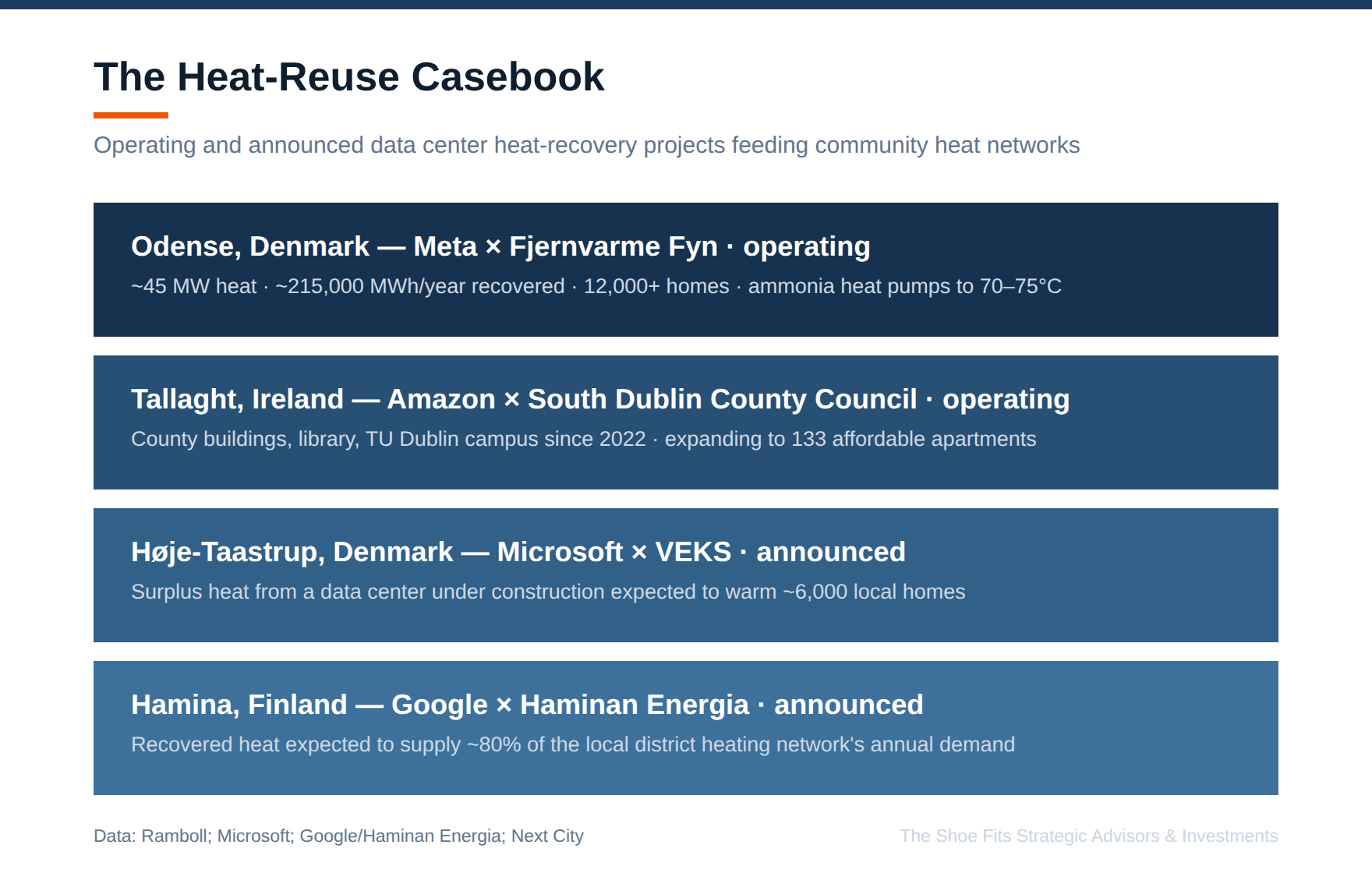
The heat-reuse casebook is no longer hypothetical. Odense and Tallaght are operating. Høje-Taastrup and Hamina are engineered and announced. The common thread: a district energy partner and early planning.
Why This Is Harder Than the Press Release
Now the honest part, because a benefit that cannot be delivered will damage trust faster than no benefit at all.
Waste heat reuse is not plug-and-play, and the physics explains why.
Heat from a conventional air-cooled data center comes off at roughly 30–40°C — warm, not hot. Most district heating networks need 60°C or more. Closing that gap takes heat pumps, and heat pumps take electricity which means the economics depend on power prices, network temperatures, and distance. In Tallaght, the recovered heat is expected to cost customers roughly what gas heating costs. That is a good outcome. It is not free heat, and nobody should present it as free heat.
Distance is the second constraint. Heat does not travel well. The thermal customer, the district network, the campus, the greenhouse, has to be close, and dense. This works in a town center or an industrial park. It does not work across twenty miles of countryside.
The third constraint is durability. The receiving system is sizing infrastructure around the facility's thermal output. What happens if the data center's load profile changes, a hall is repurposed, or the operator is acquired? A heat commitment needs the same things a water commitment needs: a contract, a measurement regime, an operating owner, and successor obligations. Episode 2's four questions apply without modification. What is promised? How is it measured? Who verifies it? What happens if the promise is not kept?
And one more factor, this one is actually good news. The AI buildout is pushing the industry toward direct-to-chip liquid cooling, because today's chips are outrunning air. Liquid cooling returns heat in a concentrated liquid stream at higher temperatures than air systems. That makes recovery meaningfully more practical. The same technology shift that is driving the power demand is quietly improving the case for heat reuse. Projects being designed today have fewer excuses than projects designed five years ago.
What About Places Like Louisiana?
I am not going to pretend Richland Parish is Denmark. Louisiana has about 4.6 million people, more than 3 million wild alligators, and roughly half as many residents as Denmark. Put differently, we are closer to having a gator for every Louisianan than we are to becoming Copenhagen.
Our climates, population densities, infrastructure, and energy needs are fundamentally different.
District heating barely exists in the American South, and residential heating demand is modest. The honest answer is that residential heat networks, the traditional European model, will primarily fit cold-climate, densely populated markets.
In hot and mixed climates, the thermal customer looks different. It may be an industrial user that needs process heat, an agricultural operation, a greenhouse or aquaculture facility, a drying or dehumidification system, a university or hospital campus, or an absorption-cooling system that converts recovered heat into chilled water.
Some of those opportunities will pencil. Many will not.
But here is what I know from the utility side of the fence: asking the question costs almost nothing during site selection and can cost almost everything after design is complete.
The cooling architecture either preserves the heat-recovery option or forecloses it. The interconnection is either planned early or becomes impractical later. A region preparing to host gigawatts of thermal output should at least inventory its potential thermal loads before the design freezes.
Because the alternative is what usually happens: the option quietly disappears, and no one can say exactly when the decision was made.
Ask the Heat Questions Early
Questions to ask during site selection — not after the ribbon cutting:
Is there an existing or planned district heating or thermal network nearby?
Are there schools, hospitals, municipal buildings, campuses, greenhouses, or industrial users that need heat?
Can the data center cooling design support heat recovery — and does the liquid-cooling roadmap improve it?
What temperature and volume of heat can realistically be provided?
Who owns the interconnection infrastructure? Who operates and maintains it?
How will performance be measured, and who verifies it?
What happens if the data center load profile changes?
Do the commitments survive a sale of the facility?
These are engineering and commercial questions, not marketing slogans. A community benefit that cannot be delivered will damage trust. A benefit that is engineered, contracted, measured, and explained can strengthen it.
For developers and investors, the same list reads differently — and it should. Waste heat reuse is not only a sustainability talking point. It is a risk-reduction and value-creation tool. In the right project, it differentiates a site, improves community alignment, supports the permitting narrative, monetizes an energy stream the design was going to throw away, and builds the kind of durable operating relationship that Episode 1 argued is now part of the infrastructure stack.
And notice how the two halves of this episode meet: a project that has answered the power question honestly — full cost of service, enforceable terms, disclosed risk — and engineered the heat question early is a project with a fundamentally different public story. Not "trust us." Here is what we take, here is what we pay, here is what we return.
The Full Energy Ledger
At The Shoe Fits, we believe the best infrastructure planning looks for value beyond the fence line.
Power strategy and heat strategy are the same ledger. The front end — generation, contracts, risk allocation, ratepayer protection — decides whether a community pays for someone else's growth. The back end — heat recovery, where it fits — decides whether the community gets anything tangible back from the energy flowing through the building.
Waste heat reuse will not fit every project. Neither will every generation model. But both questions should be asked early enough to matter — during site selection, before the design freezes, before the public meeting.
Because community benefit is strongest when it is designed into the project — not bolted on after opposition begins.
The strongest projects engineer the public answer before the public meeting.
Because approval matters.
But acceptance matters too.
Connectivity. Strategy. Execution. Value.
Episode 3 of 6. Next: the network beneath it all — fiber, routes, and rights-of-way: how connectivity gets built, who digs where, and why the quietest utility in the ground shapes everything above it.
Sources & Further Reading
Power, risk, and ratepayers
Entergy Louisiana receives LPSC approval for major infrastructure investments — Entergy
The three-plant approval, Waterford timing, transmission, and 1,500 MW solar authorization.
Entergy Louisiana announces a new agreement with Meta delivering an additional $2B in customer savings — Entergy
The expanded seven-plant, 5,200+ MW agreement, 240 miles of 500 kV transmission, cost-of-service structure, and the Ratepayer Protection and Fair Share pledges.
"Advocates cite lack of transparency, rising costs as regulators fast-track second Meta data center" — WWNO (April 2026)
The 4–1 fast-track vote, ALJ bypass, NDA and redaction concerns, gas-dependence figures, and the November 18, 2026 final vote.
"Entergy Wants to Fast-Track Gas Plants for Meta Data Center" — Union of Concerned Scientists
The stranded-asset and duration-mismatch critique.
"Louisiana creates fast track to approve power plants for data centers" — Louisiana Illuminator (December 2025)
The accelerated regulatory pathway.
"Projected data center growth spurs PJM capacity prices by factor of 10" — IEEFA
Capacity-auction analysis.
"Data centers drive 76% surge in PJM power prices" — E&E News
Attribution of capacity price increases to data center load.
Citizens Utility Board on sustained high PJM capacity prices (July 2026)
Consumer-side view of auction results.
"Three Mile Island nuclear power plant to return as Microsoft signs 20-year, 835MW AI data center PPA" — Data Center Dynamics
The Crane Clean Energy Center restart.
"Constellation Secures $1 Billion Federal Loan for Three Mile Island Restart" — NucNet (November 2025)
Federal loan guarantee.
Onsite generation and air quality
"Environmental Groups Contest Texas Data Centers' Air Pollution" — Inside Climate News (July 22, 2026)
The notice of intent to sue over the Omicron Drive and Rogers Road campuses, the minor-source permitting theory, the pollutants named, and responses from Vantage and the TCEQ.
"Environmental Groups contest San Antonio data centers' air pollution" — San Antonio Current (July 26, 2026)
Neighborhood siting and the residential context.
"Vantage, VoltaGrid face lawsuit concerning natural gas powered off-grid data centers in San Antonio, Texas" — Data Center Dynamics
The 423 MW of gas generation and 151 diesel generators totaling 454 MW, and the 60-day notice window.
"New Study Finds On-Site Power at Virginia Data Center Could Result in $53 Million–$99 Million in Annual Health Damages" — Piedmont Environmental Council (March 4, 2026)
The EmPower Analytics Group modeling of 135 MW of onsite generation in Loudoun County using EPA's COBRA model.
"Emails show how Virginia regulators downplayed data center health concerns" — E&E News by POLITICO (July 25, 2026)
The internal DEQ correspondence obtained through public records requests, the “defensible critique” directive, the staff response, the premature-death and emissions figures, and the outside expert commentary on health effects below the federal standard.
"Piedmont Environmental Council Response to Department of Environmental Quality Air Quality Report" — Piedmont Environmental Council (April 29, 2026)
The “compliance question” versus “health question” framing and PEC's position that these proposals should be reviewed as major new sources.
"EPA weighs eliminating public comment requirements for a common data center air permit" — KJZZ (July 16, 2026)
The proposed removal of the federal 30-day public notice requirement for minor-source permits.
Waste heat reuse
"Meta: surplus heat to district heating" — Ramboll
The Odense system: ~45 MW, ~215,000 MWh/year, 12,000+ homes, ammonia heat pumps to 70–75°C with Fjernvarme Fyn.
"Surplus datacenter heat will be repurposed to heat homes in Denmark" — Microsoft Local
The Høje-Taastrup project and the ~6,000-homes expectation.
"Our first offsite heat recovery project lands in Finland" — Google
The Hamina project and the 80%-of-district-heat-demand figure attributed to Haminan Energia.
"Waste data center heat is warming up Dublin homes. Is it working?" — Next City
The Tallaght District Heating Scheme: buildings served, temperatures, heat-pump economics, and cost parity with gas.
Schneider Electric and IBM Research on direct-to-chip liquid cooling
Why liquid cooling raises return temperatures and improves heat-recovery feasibility.
Figures reflect company announcements, regulatory filings, and reporting as of late July 2026. The Louisiana proceeding is active — the LPSC's final vote on the expanded generation plan is scheduled for November 18, 2026 — so verify current docket status before relying on any term described here.