
Water Strategy Belongs in Data Center Site Selection
Power, land, water, fiber. Water is the question most likely to decide whether a project is trusted — and the one most often answered after the public meeting instead of before it.
The strongest projects engineer the public answer before the public meeting.
In Episode 1, I made the case that community acceptance has become part of the infrastructure stack. That it is no longer a communications exercise. That it is project risk.
Water is where that argument stops being abstract.
Power is negotiated with a utility. Land is negotiated with an owner. Fiber is negotiated with a carrier.
Water is negotiated with everybody.
It is the one input a data center shares directly with the family down the road, the farmer irrigating the next section, and the town trying to keep a treatment plant inside its permit. It is measured in gallons a resident can picture. And when it goes wrong, it does not go wrong quietly.
When a project is announced, one of the first questions a community asks is simple: where does the water come from?
That question deserves a serious answer. The strongest projects treat water as a planning constraint, not a public-relations problem.
So this episode is about a single argument:
Water strategy is not a sustainability statement. It is a site-selection gate.
Water Is Not a Sustainability Topic. It Is an Engineering Question.
Start with scale, because the scale is real.
U.S. data centers directly consumed roughly 17.4 billion gallons of water in 2023, with projections running to somewhere between 38 and 73 billion gallons by 2028. A typical facility uses around 300,000 gallons a day. A large one can use up to 5 million — the daily draw of a town of 10,000 to 50,000 people.
And here is the part that gets lost: in evaporative cooling, up to 85% of the water a data center withdraws evaporates and never returns to the supply.
That distinction between withdrawal and consumption is not a technicality. It is usually the entire argument. A project that withdraws a lot and returns most of it is a different neighbor than one that withdraws less and consumes nearly all of it. Most public conversations never separate the two.
And not all data centers use water the same way. Some designs rely heavily on air cooling. Some use evaporative cooling only during hot periods, to improve efficiency when it matters most. Others run closed loops, dry cooling, or hybrids of all of the above. AWS, where I spent part of my career, says its data centers often run on air cooling with no water through much of the year, may use direct evaporative cooling during hot periods, and can substitute recycled water for drinking water when they do.
That distinction matters too. A community does not need vague language about "efficient cooling." It needs the actual strategy: which source, when it will be used, at what peak, and under what drought conditions.
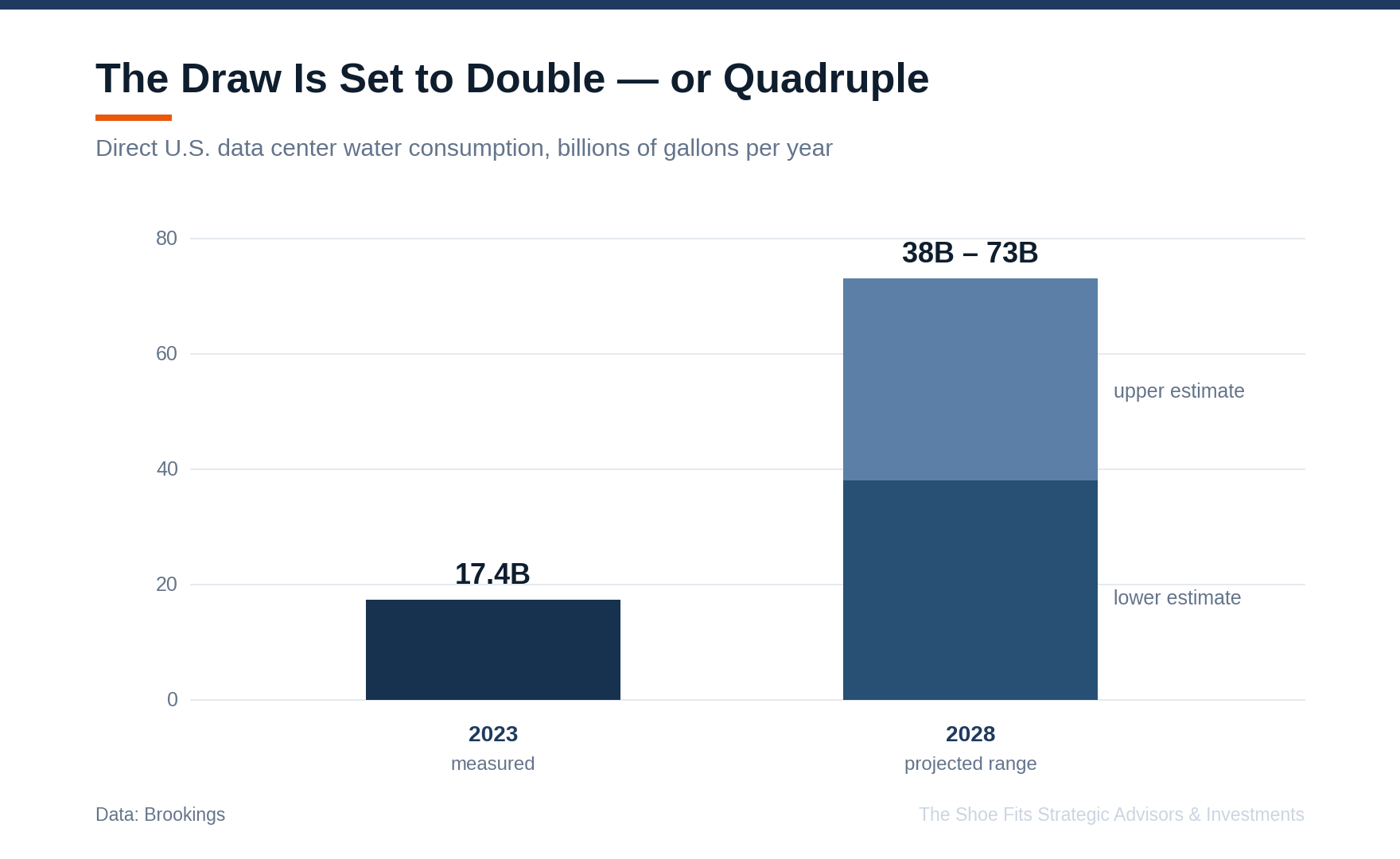
Caption: U.S. data centers directly consumed about 17.4 billion gallons in 2023. Projections for 2028 run from 38 to 73 billion — and the width of that range is itself a symptom of how little standardized reporting exists.
Virginia shows the trajectory. Data center water consumption there climbed from 1.13 billion gallons in 2019 to 1.85 billion in 2023; a 65% increase in four years. That is Loudoun County, the place I lived. The growth curve residents were watching was not hypothetical to them, and it will not be hypothetical here.
I have been on both sides of that disruption. In Virginia, I experienced water interruptions caused by utility hits during nearby construction. And on one project, I watched it from the other side of the fence line: vendor teams supporting our work hit a water main serving a neighborhood near Dulles. The crews worked quickly to identify and repair the damage. Homes still went more than six hours without water and when service came back, residents had to run their taps for ten minutes or more to clear the dirt and contaminants from their lines.
That kind of damage is not unique to data centers. It happens in utility construction, road improvements, and general construction. The mitigation is not complicated either: safe digging practices, prompt repairs, and direct communication with the people affected. Our vendor worked one-on-one with the homeowners adjacent to the damage to limit the disruption and to make sure the landscaping repairs left every yard like new or better.
Six hours without water is a line in an incident report. It is a very long evening in a house full of children. I know which one the neighborhood remembers.
The Gap Between Permitted and Promised
Here is the pattern I keep seeing, and I think it is the single biggest unforced error in this industry.
A project registers for a maximum water entitlement sized for the worst imaginable day. Then it tells the community what it expects to use on an average one. Both numbers are true. Only one is enforceable. And the community is asked to trust the smaller one.
Google ran straight into this in Berkeley County, South Carolina. The company sought permission to withdraw as much as 1.5 million gallons a day from a stressed drinking-water aquifer, three times its previous permitted amount, at a moment when other users were being asked to pull back. Google described the request as backup and diversified capacity, well beyond projected normal need.
It did not matter. The maximum entitlement became the public focus.
The eventual agreement required Google to use groundwater only when alternatives were unavailable, and to report groundwater use publicly every quarter. That is a reasonable outcome. It just arrived after the fight instead of before it.
The lesson is not "ask for less." Reliability planning is legitimate. Engineers size for contingency because that is the job. The lesson is that a large emergency entitlement is nearly impossible to defend without a published source hierarchy, honest frequency assumptions, drought restrictions, and monitoring attached to it from the start.
Present normal, peak, emergency, and drought demand separately. Secure alternative supplies first. Make groundwater a bounded contingency, not an open-ended right.
Because if you do not explain the gap between permitted and promised, someone else will explain it for you.
Peak Is the Number That Builds the Pipe
Average annual consumption is the number that gets a project approved.
Peak-day demand is the number a community actually has to build for.
Researchers at UC Riverside put real weight behind this. Without new efficiencies, they estimate data center cooling could require somewhere between 697 million and 1.45 billion gallons of additional peak capacity per day within about four years — roughly the daily water supply of New York City. On a hot summer day, a single large facility can withdraw more than a million gallons, and some facilities under construction have been allocated up to 8 million gallons daily.
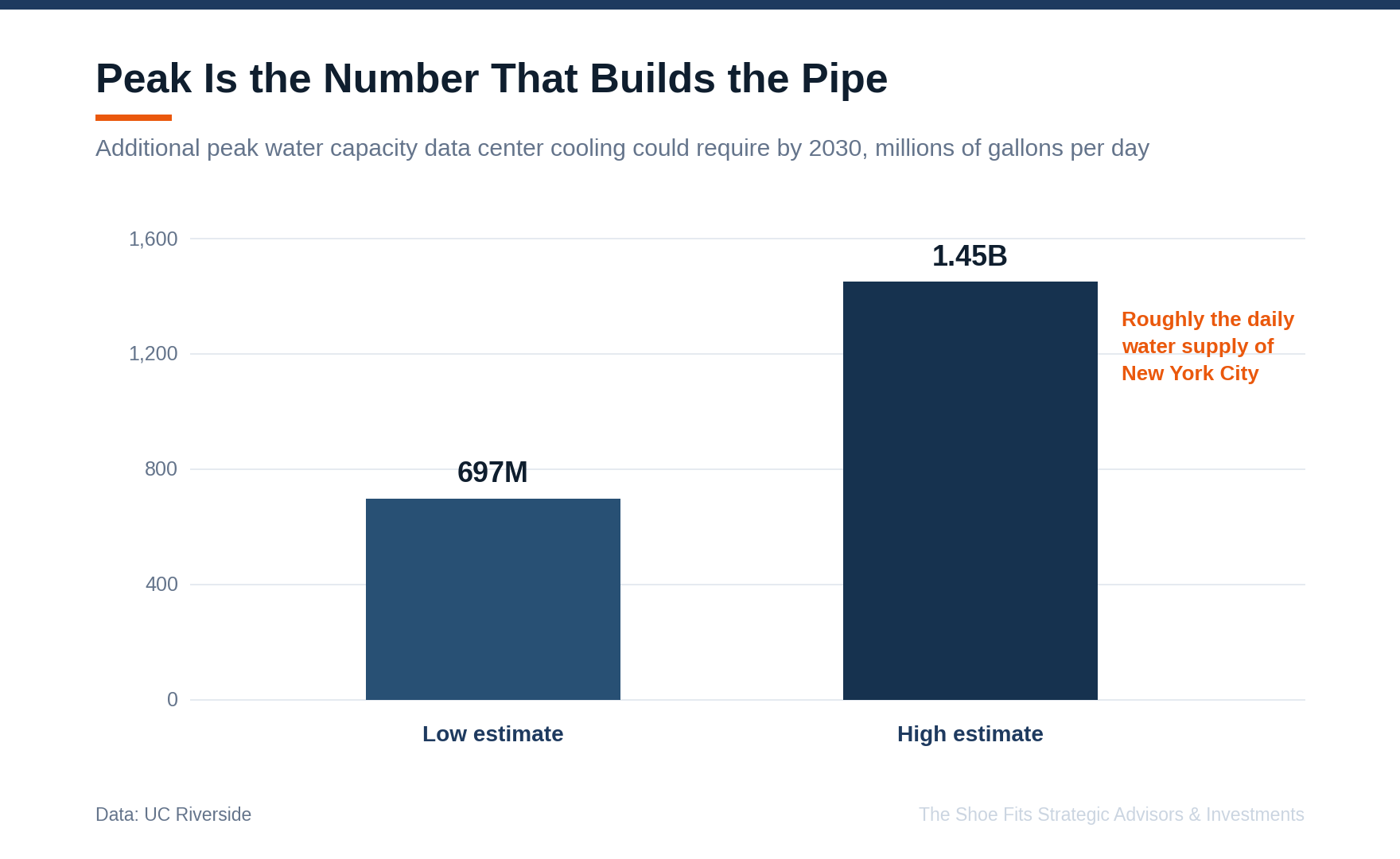
Caption: UC Riverside researchers estimate data center cooling could require 697 million to 1.45 billion gallons of additional peak capacity per day by 2030 — roughly the daily water supply of New York City. Annual averages hide exactly the days that stress the system most.
Meeting a peak is not an accounting exercise. It means someone builds treatment plants, storage reservoirs, pump stations, transmission pipelines, and wastewater capacity sized for the worst day of the year and then maintains all of it during the other 364. The researchers' recommendations are blunt and correct: developers should report peak water use, not just annual averages, because annual figures hide exactly the periods when the system is under the most stress. They go further, corporate-community partnerships, coordinated water-and-power planning, and what they call a "water capacity neutral" approach, so that a host community keeps its limited capacity instead of quietly ceding it.
Spotsylvania County, Virginia shows how fast this becomes structural rather than theoretical. The county built a genuinely sophisticated reu treatment plants, storage reservoirs, pump stations, transmission pipelines, and wastewater capacity sized for the worst day of the year, and then maintains all of it during the other 364. The researse program; advanced treatment, industrial funding, pretreatment permits, monitoring, dedicated infrastructure. Roughly 13 miles of supply and return pipeline. It is a model worth copying.
And by mid-2025, county officials were reported as saying the planned reuse capacity was already committed, based on approved and pending data center projects.
Read that carefully, because it is the whole point: a utility can approve a series of individually reasonable projects and still run out of room. Every project can pass on its own merits and the system can still fail on the aggregate.
That is not a developer problem or a community problem. It is a governance gap. Regional planning needs a public capacity ledger; existing users, approved projects, pending projects, peak demand, return flow, temperature, chemistry, treatment limits, and the completion dates of every upgrade the plan depends on. With expiration rules for reservations that never get built.
This Is Not a Story About Good Companies and Bad Companies
I want to be careful here, because it would be easy to turn this into a list of villains. That would be dishonest, and it would be useless.
The right unit of analysis is the project and the process, not the company.
The same operator can run an exemplary water partnership in one market and a contested one in another. Site conditions differ. Utility capability differs. Contracts differ. Disclosure rules differ. Local leadership differs, and it differs enormously.
Google built one of the best reclaimed-water cooling partnerships in the country in Douglas County, Georgia. Google also fought disclosure of its water use in The Dalles, Oregon, and asked for a groundwater entitlement in Berkeley County that it spent months walking back.
Same company. Different processes. Different outcomes.
That should be encouraging, not cynical. It means the outcome is not determined by which logo is on the building. It is determined by how the work is done.
What Strong Actually Looks Like
Two operating examples are worth more than any pledge.
Quincy, Washington. Microsoft and the City of Quincy built the Quincy Water Reuse Utility to treat data center cooling blowdown and return it for reuse. EPA reports a $31 million project offsetting an estimated 138 million gallons per year of potable groundwater demand, under a 30-year agreement in which the city owns and operates the system while Microsoft financed the capital and operating costs.
What makes Quincy the best case in the country is that it solved both problems at once. The local groundwater was high in minerals and hard on cooling equipment. The mineral-rich blowdown was hard for the municipal plant to treat. One system fixed both, separating the industrial stream from the municipal one and managing concentrated salts through lined brine ponds and approved disposal.
Future data centers can connect. They pay connection fees, upgrade costs, and their share of operations. The public owns the asset.
EPA specifically credits public engagement, institutional support, and broad local acceptance as reasons it worked.
Douglas County, Georgia. Google and the Douglasville-Douglas County Water and Sewer Authority built a system that diverts treated municipal wastewater, treats it further, and uses it for cooling, capable of meeting the facility's full cooling demand with recycled water. The authority's interest was drought resilience and protecting public supply capacity. Remaining water gets additional treatment before returning to the environment.
The principle underneath both is simple and, once said out loud, obvious: drinking-quality water is not required to cool a server. Fit-for-purpose water use protects the reservoir, the aquifer, and the relationship.
Both projects also share something less obvious. Neither treated water supply, cooling chemistry, wastewater compatibility, infrastructure ownership, and cost recovery as separate permitting questions. They designed them as one system.
That is what "water strategy" actually means. Not a pledge. A design.
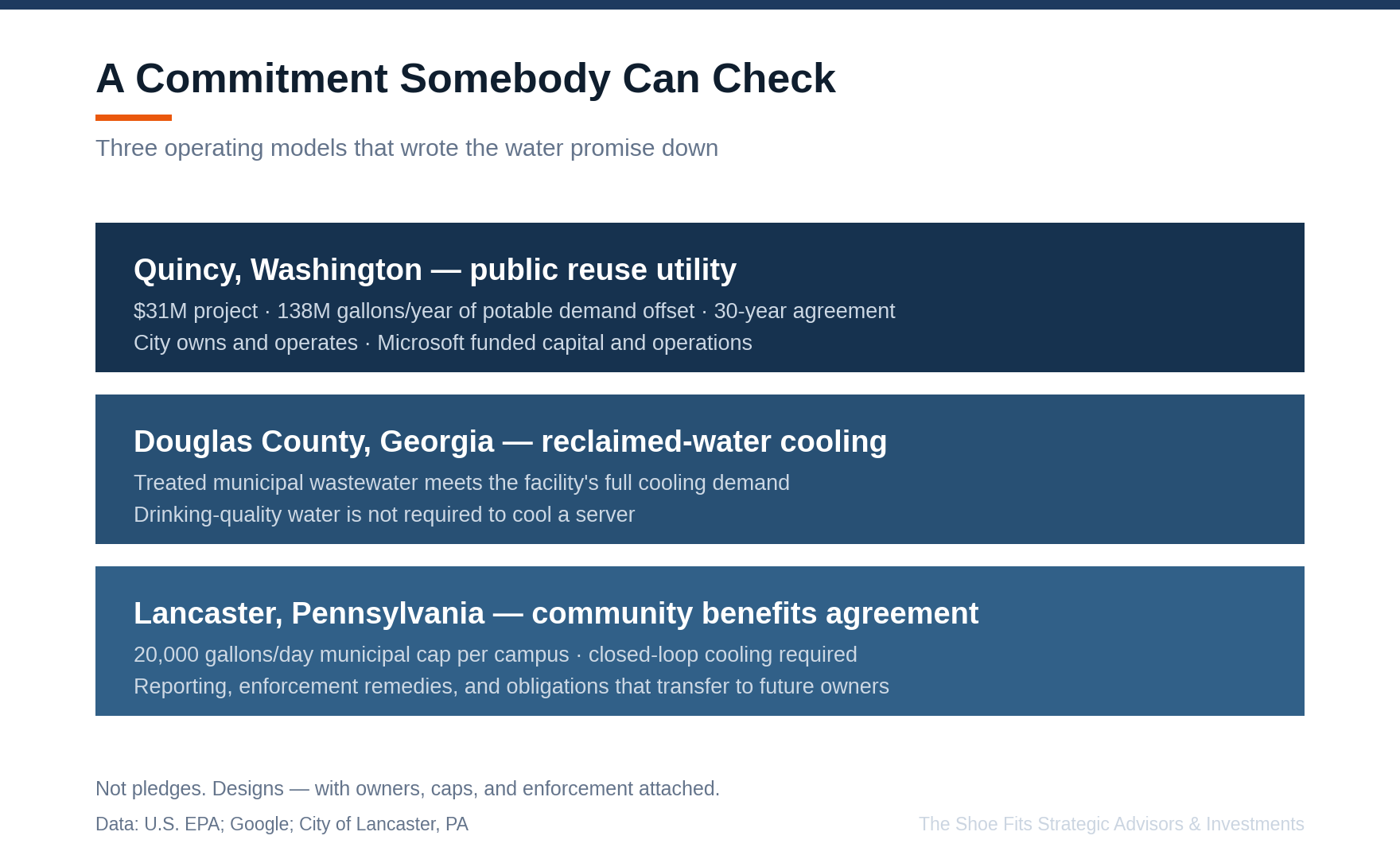
Caption: Quincy, Douglas County, and Lancaster each turned water strategy into something a community can verify: a reuse utility the city owns, a reclaimed-water system meeting full cooling demand, and a daily cap written into an enforceable agreement.
Closed-Loop Does Not Mean No Wastewater
This is the most important technical point in this piece, and it is the one I most often hear stated wrong, including by people who should know better.
"Closed-loop" is a real improvement. It is not a magic phrase.
A closed-loop design does not eliminate wastewater. It changes when and how wastewater is generated.
Cheyenne, Wyoming is the live illustration. Cheyenne's Board of Public Utilities reported that an industrial user discharged a biological contaminant that disrupted both of the city's wastewater reclamation facilities. The utility identified the organism, terminated the user's discharge privileges, took the reuse system offline, drained and disinfected it, and temporarily switched affected irrigation systems over to potable water. Subsequent reporting identified the industrial user as a contractor associated with Meta's data center construction.
Note when this happened: before normal operations began. This was commissioning. Fill-and-flush water, pipe cleaning, hydrostatic testing, passivation, chemical treatment; the temporary discharges nobody puts in the community presentation because the operating design is closed-loop and the slide says zero.
I want to be fair about the status of this one. As of mid-July 2026, Meta had appealed the utility's notice and argued that supporting evidence had not been fully shared. This is active and disputed. It is not a final adjudication, and I am not going to treat it as one.
But the engineering lesson does not depend on who wins the appeal.
Every construction and commissioning discharge needs to be laboratory-characterized, pre-approved, monitored, assigned to a permitted party, and backed by an off-site disposal alternative and an incident-response plan. Before the first pipe is filled.
That is not a compliance detail. In Cheyenne, a startup discharge took a public reuse system offline and put potable water into irrigation lines. The community experienced that as a water event. Nobody in town cared that the operating design was closed-loop.
Write the Promise Down
If community trust is project risk, then the currency of trust is a commitment somebody can check.
Lancaster, Pennsylvania is the clearest governance example available right now. Chirisa Technology Parks and the City of Lancaster converted water commitments into a public Community Benefits Agreement: municipal water capped at 20,000 gallons per day per campus, closed-loop cooling required and designed to minimize municipal use, wastewater limited to permitted sewer capacity.
The cap is stated publicly and compared against the prior industrial user on the site — which gives residents something a percentage never gives them: a reference point they can hold.
And the agreement addresses what happens after approval. Reporting. Complaint procedures. Financial security. Enforcement remedies. Obligations that transfer to a future owner.
That last one matters more than people realize. Infrastructure assets change hands. A promise that evaporates at closing was never a commitment; it was marketing.
Trust is not built by saying, "We will be good stewards."
Trust is built when stewardship is engineered, funded, measured, and reported.
A strong community agreement answers four questions:
What is promised?
How is it measured?
Who verifies it?
What happens if the promise is not kept?
If a project cannot answer all four, it does not have a water commitment. It has an intention.
What a Strong Water Plan Discloses Before Approval
Here is the standard I would apply to a site today. Not after entitlement. Not in the sustainability report. Before the public meeting.
Every source. Potable, non-potable, reclaimed, surface, groundwater, stored, and emergency backup — with a hierarchy showing what gets used first and what is contingency.
Every demand condition. Average annual, peak day, peak month, commissioning, maintenance, and drought. Separately. Not blended into one number.
The cooling technology and its consequences. Operating conditions that trigger water use, expected cycles of concentration, and consumptive loss through evaporation.
The utility's real capacity. What exists, what remains after every approved and pending project, and the completion dates for required upgrades.
Every wastewater stream. Cooling blowdown, fill-and-flush, hydrostatic test water, cleaning and passivation solutions, glycol-bearing water, chemical residuals, maintenance discharge.
The monitoring regime. Pretreatment limits, laboratory testing, continuous monitoring, temperature controls, storage and equalization, sampling access, reporting frequency.
Who pays. Treatment, conveyance, pumping, storage, metering, monitoring, utility staffing, emergency response, repair, and future expansion.
Public reporting. Source volumes, consumptive use, discharge volumes, incidents, violations, and progress against stated goals.
Failure planning. Drought curtailment, emergency source-switching, off-site disposal, incident notification, service disconnection.
Enforceability. Caps, financial security, remedies, successor obligations, and expiration rules for capacity reservations.
That list looks long. It is shorter than a zoning fight.
Every item on it is something a developer's engineers already know. The only question is whether the community learns it from the project team early, or from a reporter later.
And timing is the whole game. If water risk is evaluated late, the options narrow. The site is under contract. The utility path is assumed. The cooling design is locked. The public narrative is already forming. Evaluated early, every one of those is still a choice — a different source, a different design, a reclaimed-water line, a wastewater upgrade that becomes part of the community benefit, a reporting commitment made before it is demanded.
Sometimes the answer is that a site that looks attractive gets passed over because the water risk is too high.
That is not a failure. That is disciplined infrastructure planning.
Back Home in Northeast Louisiana
I did not write this from a distance. This conversation is happening about thirty miles from my house.
Meta's Richland Parish project is registered to draw more than 23 million gallons of water per day — about 8.4 billion gallons a year. Meta says actual use will run closer to 500 to 600 million gallons per year once the facility is running, an average near 1.5 million gallons a day.
That is roughly a fifteen-fold gap between the registered maximum and the stated expectation.
I want to be precise, because precision is the whole point of this piece. Neither number is a lie. The registered figure is an entitlement sized for hot-weather peaks. The lower figure is an operating estimate. Meta commissioned a third-party groundwater study, received state approval that maximum pumping would not impact local systems, and reports that its testing found no land subsidence, which the company has an obvious self-interest in avoiding, since subsidence under your own facility is not a good outcome for anybody.
And independent researchers looked at the same site and reached a more cautious conclusion. An LSU team ran a 17-year simulation assuming maximum daily withdrawal and found groundwater levels dropping more than 65 feet beneath parts of the facility, with a cone of depression extending past the property line. There are scores of agricultural and domestic wells nearby, roughly 50 within a mile of the perimeter.
Both of those things can be true. The maximum is unlikely. The maximum is also what is permitted.
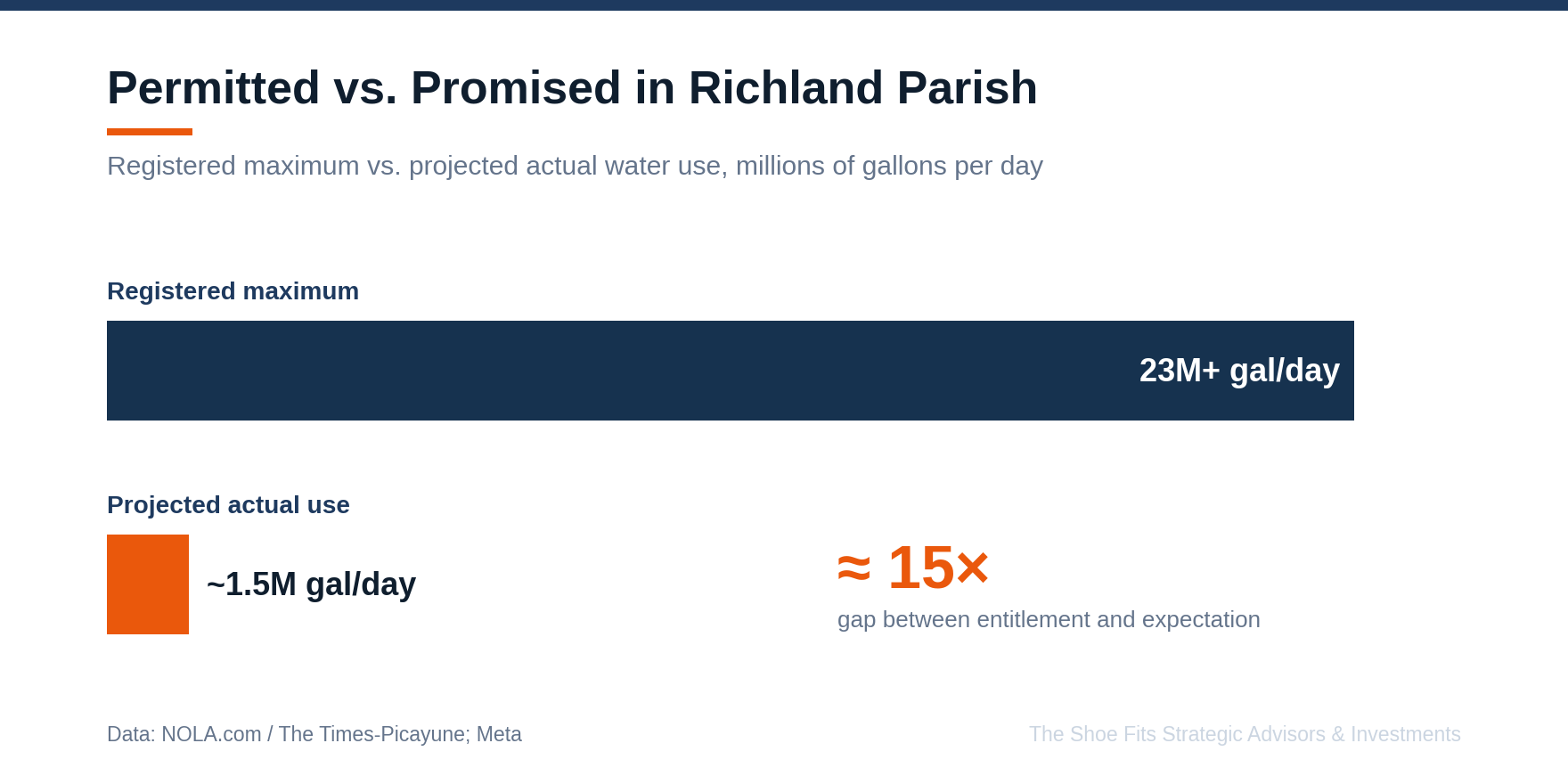
Caption: Richland Parish, permitted vs. promised: the registration allows more than 23 million gallons per day, while Meta projects roughly 1.5 million gallons per day of actual use once operations stabilize. On an annual basis, Bloomberg has reported the site could use up to 1 billion gallons; Meta says 500 to 600 million. Neither number is a lie. Only one is enforceable.
That is the Berkeley County lesson arriving in Louisiana, and we have the benefit of knowing how that one went.
There are real commitments here worth naming. The water comes from the Mississippi River Alluvial Aquifer rather than the Sparta, a distinction that gets muddled locally and matters, because the Sparta is separately depleted and supplies drinking water to something like a quarter-million people across north Louisiana. Meta is building a new wastewater treatment facility in partnership with the town of Delhi. The company has committed to being water positive by 2030 and says the site will use roughly the same annual volume as the 2,500 acres of irrigated cropland it replaced. Meta also reports that its local infrastructure investment in roads, water, and wastewater systems that has grown past $300 million, and that water restoration partnerships are intended to return 100% of the data center's water consumption to the Boeuf, Tensas, and Lower Mississippi watersheds.
That kind of commitment matters. It also raises the bar for transparency: which systems are being improved, who owns them, who pays for them, who maintains them, and how performance will be tracked over time. A water improvement that only serves the project may be necessary. A water improvement that also strengthens the community is more powerful.
And there is a real gap. Louisiana does not maintain an inventory of water use, so Meta is not required to report it. The company voluntarily agreed to submit annual reports for its first five years.
Voluntary and five years.
I am not saying that in bad faith. It is more than the state requires. It is also exactly the kind of commitment that Lancaster wrote down and Berkeley County had to negotiate under pressure and the difference between a voluntary practice and an enforceable one shows up years later, under a different management team, in a drought nobody planned for.
There is one more piece nobody local is connecting, and it deserves saying plainly.
The Richland Parish design is closed-loop. Closed-loop uses less water and more energy. The facility is expected to increase Entergy's electricity needs by roughly 30% statewide and thermoelectric generation consumes water too. Water for two of those plants is planned to come from Delhi.
So the water footprint does not disappear. Part of it moves upstream, from the cooling tower to the power plant, where it is somebody else's line item and nobody's headline.
That is not an argument against closed-loop. Closed-loop is the right call here. It is an argument for counting honestly.
I can also speak to the other side of this table, because I sat at it.
At AWS, water strategy applied to every site. A dedicated team reviewed the water requirements and community impact of every new data center location. They worked with local municipalities and water providers to confirm that quality, treatment, and availability were there and that the immediate local community would not be affected.
That team had veto authority over new site selection.
Inside one of the largest hyperscale operators in the world, water could stop a site. That is not a talking point. That is an org chart.
I watched two sites in Prince William County delayed for exactly this reason the water demand and its impact on the local community. The developers did not abandon the projects, and they did not push them through. They worked directly with the local water utility to build additional pumping stations and a new water treatment plant. The delays cost real money.
They were the right call.
So when I say water strategy is a site-selection gate, I am not proposing something new. I am describing how the strongest operators already work — and asking why any community should accept less.
Evaluate the Water Before the Fight
Data centers are worth supporting when they are built right.
Water strategy should not be an after-the-fact sustainability statement. It should be a site-selection gate; supported by utility engineering, transparent assumptions, enforceable agreements, and community access to the facts.
Quincy shows it can be done. Douglas County shows it can be done. Lancaster shows it can be written down. Cheyenne shows what a startup discharge can do to a public system. Berkeley County shows what happens when the maximum becomes the message. Spotsylvania shows that individually reasonable projects can still exhaust a region.
None of that is anti-growth. All of it is engineering.
Source, treatment, return flow, cost, monitoring, capacity, drought response, and long-term accountability are one integrated plan — or they are eight separate arguments you will have in public, one at a time, on someone else's schedule.
Because communities are no longer only asking whether a project can be built here.
They are asking whether it can be built here responsibly.
The strongest projects engineer the public answer before the public meeting.
Because approval matters.
But acceptance matters too.
Connectivity. Strategy. Execution. Value.
Episode 2 of 6. Next: the power behind the projects — who builds the generation, who carries the risk, and what a 30% jump in statewide electricity demand means for everyone who pays a bill.Sources & Further Reading
Need help evaluating the water and infrastructure fit? The Shoe Fits helps developers, communities, broadband providers, contractors, utilities, and infrastructure stakeholders evaluate the practical questions behind modern digital infrastructure — from site selection and fiber strategy to utility coordination, construction planning, and community impact. We help evaluate more than the site. We help evaluate the fit.
Sources & Further Reading
Scale and peak demand
"AI, data centers, and water" — Brookings. Baseline consumption figures and the gap between typical and large-facility demand. brookings.edu/articles/ai-data-centers-and-water/
"Small Bottle, Big Pipe: Quantifying and Addressing the Impact of Data Centers on Public Water Systems" — UC Riverside (2026). The peak-capacity research: 697 million to 1.45 billion gallons of additional daily peak capacity by 2030, the case for reporting peak rather than average, and the "water capacity neutral" framework. Coverage at news.ucr.edu; paper at arxiv.org/abs/2603.02705
AWS — recycled water for data center cooling and water stewardship. Cooling-design disclosure (air cooling much of the year, evaporative cooling in hot periods), the expansion of recycled water use from 24 to 120+ U.S. locations, and the water-positive-by-2030 commitment. aws.amazon.com/water
"The Data Center Water Problem Is Soluble" — ITIF (July 2026). Argues water-minimal cooling is achievable today and that the barrier is economics and permitting, not technology. itif.org
Operating models
Water Reuse Case Study: Quincy, Washington — U.S. EPA. Financial, technical, contractual, and public-engagement detail on the Quincy Water Reuse Utility. epa.gov/waterreuse/water-reuse-case-study-quincy-washington
Google and Douglasville-Douglas County WSA reuse facility. Joint announcement and operator description of the reclaimed-water cooling system, in use with recycled industrial water since 2012. google.com/about/datacenters/locations/douglas-county/
Spotsylvania County Water Reuse FAQs. Treatment, conveyance, pretreatment, temperature, monitoring, and funding detail. spotsylvania.va.us/3144/Water-Reuse-FAQs
"Shut-off Valve: Spotsylvania's Recycled Water Supply at Capacity" — Fredericksburg Free Press. Local reporting on reuse-capacity allocation. fredericksburgfreepress.com
Governance and transparency
Community Benefits Agreement Summary — City of Lancaster, PA. The water cap, closed-loop requirement, sewer capacity limits, remedies, and successor obligations. cityoflancasterpa.gov/data-center/
"Oregon's City of The Dalles Agrees to Reveal Google's Local Water Usage" — Reporters Committee for Freedom of the Press. The disclosure dispute and settlement. rcfp.org/dalles-google-oregonian-settlement/
"Google Agrees to Limit Groundwater Use from South Carolina Aquifer" — Southern Environmental Law Center. The Berkeley County controversy and negotiated conditions. selc.org
The Cheyenne matter (active and disputed)
Notice Regarding Discharge to the Sanitary Sewer System — City of Cheyenne Board of Public Utilities. The utility's account of the contaminant, remediation, and termination of discharge privileges. cheyennebopu.org
Cowboy State Daily reporting (July 2026), identifying the industrial user and covering Meta's appeal of the notice of violation. cowboystatedaily.com
Louisiana
"How much water will Meta's Louisiana data center use?" — NOLA.com / The Times-Picayune. Registered maximum, projected actual use, the LSU simulation, and the state's monitoring gap. nola.com
Richland Parish Data Center — Meta. Operator statements on water stewardship, the Delhi wastewater partnership, the $300M+ local infrastructure investment, and the watershed restoration partnerships (Boeuf, Tensas, and Lower Mississippi). datacenters.atmeta.com/richland-parish-data-center/ and about.fb.com (December 2025 water stewardship update)
Water Resources of Richland Parish, Louisiana — U.S. Geological Survey. Aquifer structure, including the distinction between the Mississippi River Alluvial and Sparta aquifers. pubs.usgs.gov
Case-study analysis adapted from "Data Center Water Strategy: Strong and Cautionary Examples of Operators and Developers Working with Communities and Utilities," prepared for The Shoe Fits Strategic Advisors and Investments LLC, July 2026. Report is a snapshot as of that date; verify current utility records and final contracts before relying on any case as precedent.