
Noise Should Be Engineered Before It Is Explained
A neighborhood outside Manassas heard a data center before anyone modeled it. The operator eventually re-engineered 424 rooftop fans and cut the sound roughly in half — proof the problem was always solvable, and proof of how much easier it would have been to solve before the first complaint.
The Shoe Fits Strategic Advisors & Investments LLC · Connectivity. Strategy. Execution. Value.
The same engineering that quieted the data center could have been used before the neighbors ever heard it.
On May 16, 2022, a couple in the Great Oak subdivision southwest of Manassas called the police about a sound.
Not a party. Not a car alarm. A low-frequency roar and hum, with a higher-pitched screech underneath it, coming from a four-building Amazon Web Services data center complex about 600 feet from their homes. It did not stop. According to reporting by Data Center Knowledge and the Piedmont Journalism Foundation, residents measured levels as high as about 65 decibels at night — above the county's 55-decibel nighttime limit, though how that limit applied to always-on cooling equipment was itself part of the dispute.
One family moved a one-year-old's crib to the basement. Another homeowner ordered roughly $20,000 worth of new windows.
These are not people who hate the internet. They are people who could not sleep.
What happened next is the whole reason I am writing this episode, because it is both the best argument for the industry and the sharpest argument against how the industry too often sequences its work.
AWS's first fix was to wrap the rooftop exhaust assemblies in padded acoustic shrouds. Residents reported that it did not materially solve the problem. By October 2022, a senior AWS infrastructure executive had taken the lead, and residents said communication improved from there. Then AWS stopped adding wrapping around the existing configuration and did something much harder.
Its engineers modified all 424 rooftop fan and exhaust assemblies. They extended the exhaust tubes by about three feet to direct the discharge more vertically, made the fans quieter and more efficient, and redesigned the controls so the fans could run more slowly and in sync. The installation took two cranes and about four months. By August 2023, both AWS and resident measurements reportedly showed roughly a 10-decibel reduction, down to around 50 decibels. One resident said the roar no longer traveled through the house. AWS then began designing acoustical louvers to address a remaining higher-frequency sound coming through the side air intakes.
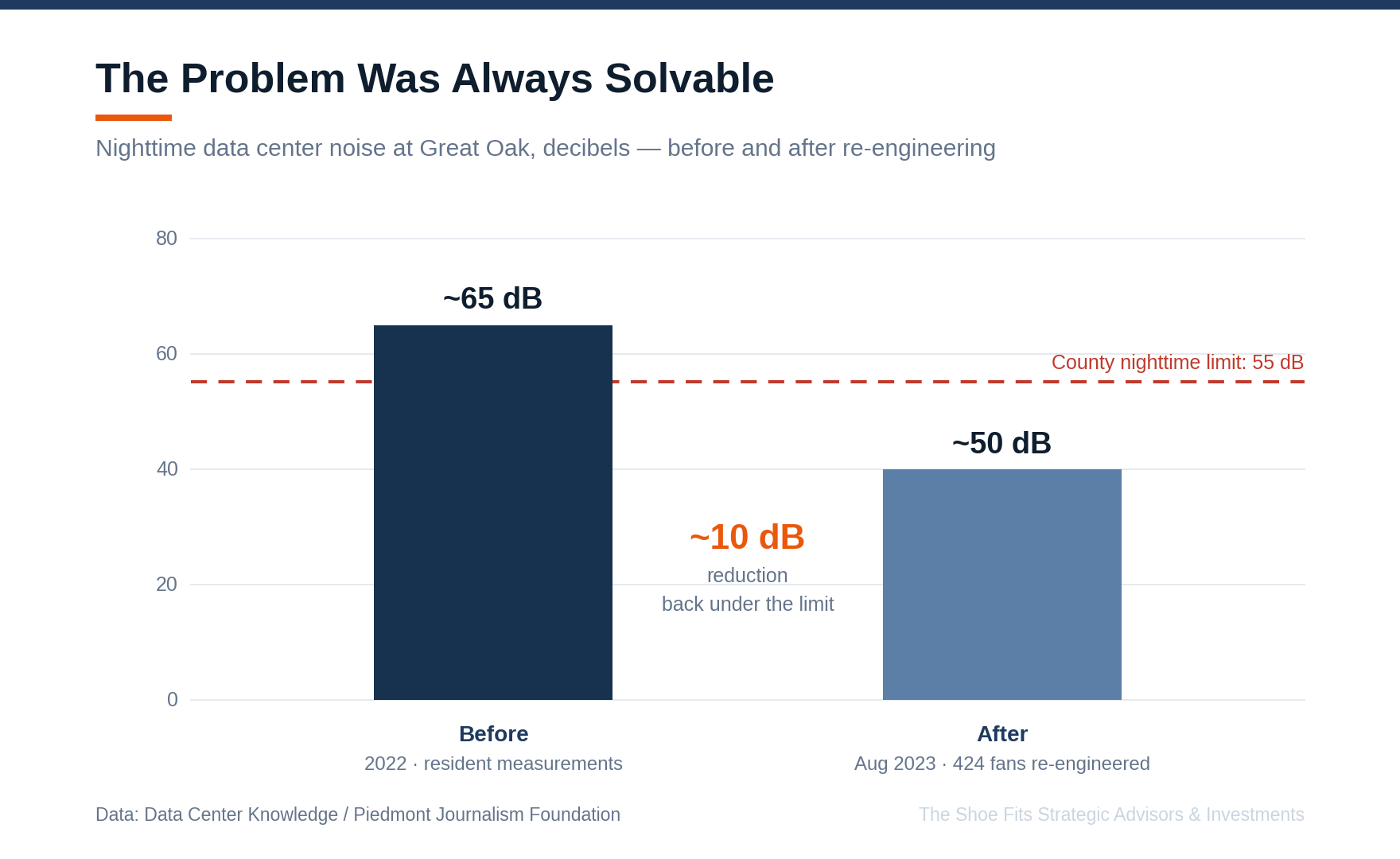
Caption: Resident measurements ran as high as ~65 dBA at night — above the county's 55-decibel limit — and fell to about 50 dBA after AWS re-engineered all 424 rooftop fan assemblies. The problem was solvable the whole time.
That is a serious engineering response. I want to give AWS full credit for it, because it is real.
And it is exactly the problem.
A Success Story and a Failure Story
Everything about the second half of Great Oak is a success. Everything about the first half is a warning.
It is a success because AWS ultimately brought genuine engineering talent to bear and achieved a measurable result, a roughly 10-decibel drop is not a rounding error, it is the difference between a sound that travels through your house and one that does not.
It is a failure because 424 pieces of operating equipment had to be re-engineered, with two cranes, over four months, after the neighbors had already spent more than a year living with the sound.
Those two facts sit in the same story, and neither one cancels the other.
The community-engagement piece deserves the same honesty. AWS said it began engaging as soon as it became aware of the issue. Great Oak residents described it differently: they said it took roughly six weeks, even with county involvement, to get the company to the table, and that AWS was initially reluctant to explain how the cooling system worked because the information was proprietary. The first formal meeting was July 22, 2022. It became a series of about fifteen meetings stretched over more than a year. AWS described the effort only as considerable engineering and resources and never put a dollar figure on it publicly; the local homeowners association president guessed the cost at somewhere around $30 million. That number is a neighbor's estimate, not a company disclosure, so read it as a rough sense of scale rather than an accounting but even discounted, it points to an expensive way to solve a problem that modeling could have caught on a drawing.
Sit with the residents' version of events for a moment: we hear something, you built it, and at first you will not tell us enough about it to explain what we are hearing.
That is the exact moment an engineering issue becomes a trust issue. Not when the sound starts. When the explanation stalls.
The lesson of Great Oak is not that AWS ignored anyone. That reading is too simple, and it throws away the more useful truth. The lesson is that the same company capable of quieting the sound afterward could have modeled it beforehand and the only thing that changed between "unbearable" and "no longer travels through the house" was the order in which the work was done.
Construction Noise and Operational Noise Are Different Problems
I spent years living in Northern Virginia's Data Center Alley, between Ashburn and Leesburg. Heavy construction was part of the landscape, and anyone who has lived near a major build knows the sounds: backup alarms, excavators, generators, saws starting early in the morning. Contractors have a real responsibility to manage that well.
But construction noise ends. The excavator leaves. The crews move on.
Operational noise does not. Once a facility goes live, its cooling equipment, fans, pumps, chillers, transformers and other systems can become part of the surrounding soundscape 24 hours a day, every day, for the life of the building.
ASHRAE specifically recognizes outdoor mechanical equipment as a potential source of community noise and recommends designing the equipment and its surroundings with acceptable sound levels in the neighboring community in mind. Fans, compressors, chillers and condensers can all contribute.
That is why noise cannot be treated as a commissioning detail. Great Oak proves the point in the negative: the sound the neighbors heard was operational, continuous, and permanent until someone rebuilt the equipment making it. It was a site-selection, equipment-selection, and design issue the entire time. It only became a commissioning issue because that is when anyone finally measured it.
Sound Is More Than a Decibel
Great Oak also shows why the argument so often turns adversarial.
A developer produces a study showing a certain number of decibels. A resident says, "I don't care what the report says. I can hear it." At Great Oak, both were arguably true at once; the residents were describing a roar, a hum, and a screech, which is three different problems, not one number.
Sound has more characteristics than loudness. There is frequency, duration, tonality, time of day, and the difference between a new sound and the environment that existed before it. A steady mechanical hum at night is a different experience from an occasional truck passing during the day, even when a meter reads them similarly.
ASHRAE notes that fan systems can generate tones tied to blade-pass frequency and that operating conditions materially affect acoustical output, and it cautions that low-frequency predictions carry greater uncertainty than the rest of the spectrum. This is also why leaning on a single A-weighted number can mislead. A-weighting is useful because it approximates human hearing, but as EPA technical material has long recognized, it deemphasizes low-frequency sound, which is precisely the roar Great Oak residents described.
It helps to put those numbers in context, because the fear and the physics do not always line up. At a neighboring home, an operational data center is usually far quieter than the sounds we tolerate without a second thought. A Fairfax County acoustical model projected 40 to 42 dBA at the nearest residential boundary during normal full-load daytime operation, and 52 to 61 dBA at the commercial boundary. The Great Oak site that opened this piece measured roughly 58 to 65 dBA before mitigation and 48 to 55 after. Inside the building, server rooms run about 70 to 80 dBA, but that is not what reaches a property line, and it should never be quoted as if it were. For comparison, freeway traffic at fifty feet runs about 70 to 80 dBA, and a concert or major sporting event commonly reaches 94 to 110.
Caption: A neighboring home hears an operational data center well below a freeway or a concert — but a continuous 60-dBA hum against a 40-dBA rural night is still a 20-decibel jump, perceptually several times louder than the quiet it replaced. Interior server-room levels of 70 to 80 dBA are not what reaches the property line.
So a problem data center is not as loud as a concert. It is often more disruptive anyway, and the reason is the entire point of this section. The sound is continuous, it carries tones, and it arrives at night, when the surrounding community may be nearly silent. A 60-dBA hum against a 40-dBA nighttime background is a 20-decibel increase — and under the common rule of thumb that every 10 decibels roughly doubles perceived loudness, that is on the order of four times as loud as the quiet those neighbors used to have.
That does not make the A-weighted decibel useless. Far from it. It means a good analysis has to understand what kind of sound is being produced, not merely whether one number falls under a limit — which is why a responsible study reports dBC alongside dBA and adds octave-band or narrowband analysis, so the low-frequency fan tones show up in the data the way they show up in a bedroom. Fairfax County's noise framework, for example, uses both A-weighted maximum limits and frequency-specific limits for stationary sources, and treats nighttime sound as more intrusive. Loudoun County's guidance for communities goes further still, recommending both dBA and dBC studies, a 50-decibel property-line limit, and mitigation of tonal noise down to background levels. That is a much better way to think about the problem than a single figure on a slide.
Source, Path, and Receiver
ASHRAE's framework for all of this is refreshingly plain: reduce the sound at its source, interrupt the path it travels, and understand the impact at the receiver. Nearly everything a developer can do about noise fits into those three words, and almost all of it is cheaper before construction than after.
Start with the receiver, by measuring the sound that is already there. Before modeling what a data center will add, someone should understand what the community sounds like today both during the day and, more importantly, at night. A site beside an interstate has a very different baseline from a rural property where nighttime ambient levels can be extremely low. That baseline turns an unanswerable argument about whether a project is "loud" into a precise engineering question: how much will we change the existing environment?
Then model the source and the path early enough to still change the design. A good model does not assume one ideal operating condition. It asks what happens at peak summer cooling, when more equipment runs at once, during generator testing, and at the nearest bedroom window at night. It looks for tonal and low-frequency components, the roar and the screech, not just the average. And it treats the site plan itself as a noise-control system, because the cheapest barrier a project owns is distance, and the next cheapest is the building. Can the structure sit between the mechanical yard and the homes? Can generators go on the far side of the campus? Can berms, screening, and quieter equipment be specified before anyone buys anything?
Procurement is where a few decibels are easiest to remove. Do not only ask how much cooling a unit provides; ask what sound it makes, across frequency bands, and what happens when it runs away from its most efficient point. ASHRAE notes that fan operating points materially affect noise and that variable-speed operation can lower it as speed drops. Multiply a few decibels across hundreds of units on a campus and the property-line difference is enormous.
And then commission the sound, not just the equipment. A commissioning team would never accept a critical cooling system because the model said it should work; we test it. Noise deserves the same treatment: measure at representative locations once the facility runs, under realistic high-load conditions and not only the quietest hour, and compare it against the design assumptions. If it misses, the owner finds out before the neighborhood does.
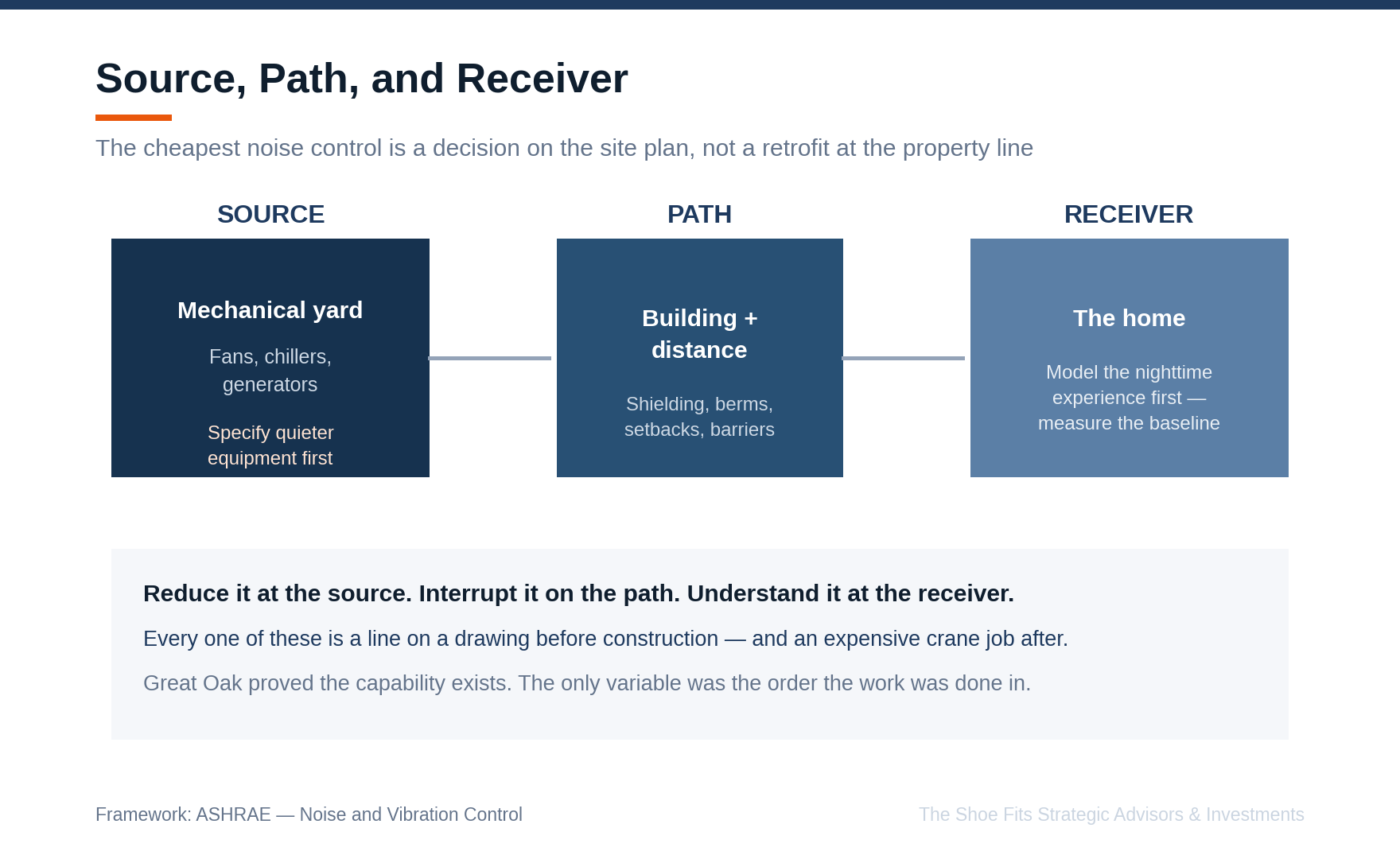
Caption: ASHRAE's framework in three words: reduce the sound at its source, interrupt it on the path, and understand it at the receiver. Every one of those is a line on a drawing before construction — and a crane job after.
At Great Oak, every one of those steps existed as a capability. The fans could be modeled, the exhaust could be redirected, the controls could be synchronized, the intakes could be louvered. All of it was possible. None of it was done in the order that would have spared the neighbors the year in between.
The Rules Are Catching Up
Great Oak is not an isolated anecdote. Northern Virginia started rewriting its rules because of experiences like it, and the progression is worth seeing as a whole.
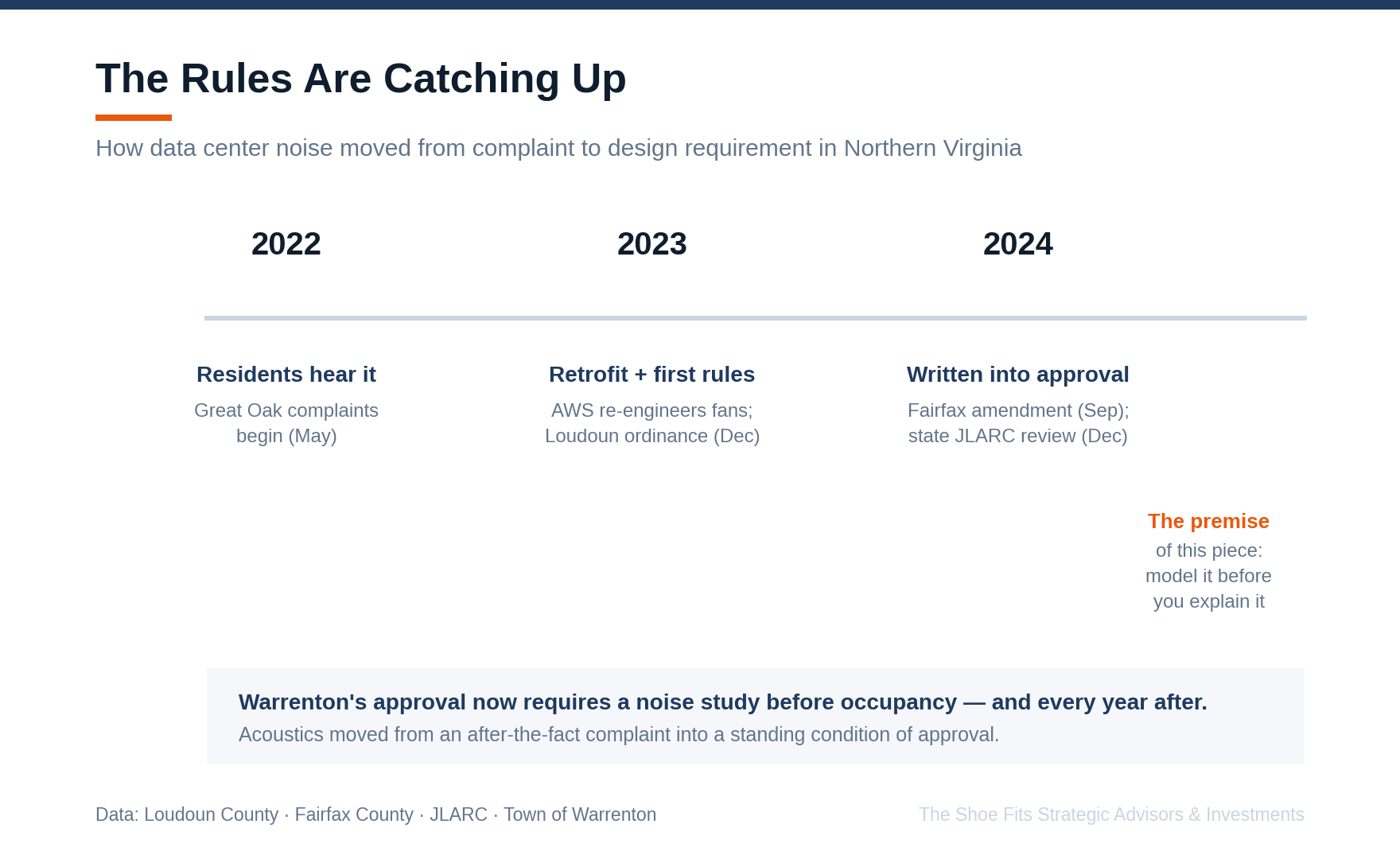
Consider the same operator's next proposal, in Warrenton. When Amazon Data Services sought approval for a data center on Blackwell Road, the Planning Commission recommended denial in December 2022, and one of the reasons it named specifically was a lack of information regarding noise. That does not mean the facility was unbuildable. It means the acoustical information available to the public process was not enough to establish confidence which is the exact gap between engineering something and earning trust around it. The project moved forward only after the framework was strengthened, and the final conditions did something notable: they required a noise study before a certificate of occupancy for each phase, another study every year for the life of the use, and mitigation if operational sound exceeds the ordinance. That is "commission the sound," written into the approval.
The zoning followed. When Loudoun County adopted its new ordinance in December 2023, it strengthened requirements for data centers near homes including soundproofing for rooftop and ground-mounted equipment, pre- and post-construction noise studies, limits on generator-testing hours, screening, setbacks, and buffers on berms. Fairfax County followed in September 2024 with its own amendment, adding residential setbacks, generator separation, and required pre- and post-construction noise studies. Then Virginia's statewide JLARC review, in December 2024, went further still, recommending that localities be given explicit authority to require sound modeling before approval and to set data-center-specific limits, including alternative metrics for low-frequency noise, the very roar that A-weighting tends to hide.
Read those dates together. In 2022 the residents heard the problem. In 2023 the operator retrofitted and the first county rewrote its rules. By 2024 acoustics were becoming a formal condition of approval across the region and a subject of state recommendations. The regulatory system is slowly arriving at the premise of this episode on its own.
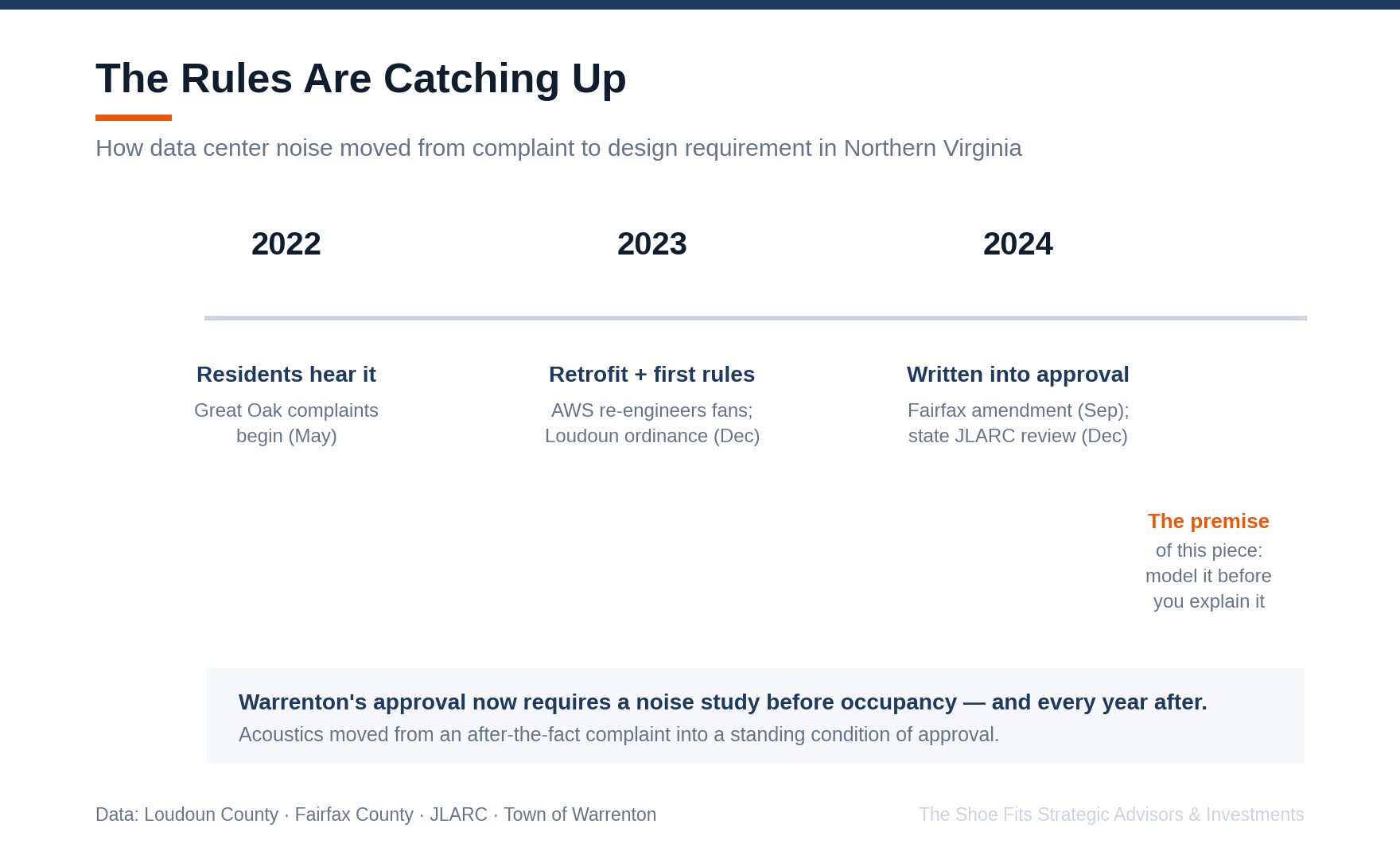
Caption: In three years, data center noise moved from a complaint a neighbor had to file to a study an approval requires. Warrenton's conditions now demand a noise study before occupancy and every year after.
It is worth noting that engagement sometimes means changing the project, not the presentation about it. When Loudoun denied the nearly four-million-square-foot Belmont Innovation Campus in early 2024, the applicant returned with a far smaller data-center footprint while keeping its buffers and community commitments, and the revised project was approved. That is a different subject from noise. But it is the same discipline: the strongest answer to a community concern is often a better project, not a better slide.
The Best Barrier Is the Fan You Never Install
The deepest form of noise control is not a wall. It is removing the thing that makes the sound.
The clearest illustration comes from outside traditional hyperscale, so I will be precise about what it is. MARA's operation in Granbury, Texas is a large digital-asset computing facility, a Bitcoin site, not a cloud data center, and it became the subject of intense community noise complaints over thousands of air-cooling fans. The prior operator had already built a sound wall roughly 24 feet high and nearly 2,000 feet long. When MARA took over in 2024, it inherited the problem, and rather than simply building the wall taller, it began removing the fans and converting the computing equipment from air cooling to liquid immersion cooling, which it described as more expensive but quieter, and commissioning third-party acoustic studies to measure the result.
I am not holding MARA up as a clean success. Community complaints persisted and there was real disagreement about whether it went far enough. That is exactly why it is useful. The technical arc is the point: fans, then a wall, then fewer fans, then immersion cooling, then independent measurement. That is a progression from fighting the path to eliminating the source, and it is the direction the whole industry is moving as cooling architectures change.
There is a forward-looking version of this on the hyperscale side, though it requires an honest caveat. Since 2021, Meta has been using simulator-based, AI-driven controls to optimize how much air its data centers move for cooling, and in September 2024 it reported that the approach cut supply-fan energy by an average of 20 percent at one pilot region while also reducing water use. Meta did not present this as a noise program and did not publish an acoustic result, so any sound benefit is my inference, not their claim. But it raises the right question for the industry: if sophisticated operators are already optimizing fan operation for energy and water, why not optimize it for sound at the property line too? Fan energy and fan noise are not the same thing, but they are close cousins. The tools to model one are largely the tools to model the other.
There is a caution here that ties this part back to the last two, and it is worth saying plainly. Changing the cooling architecture to quiet a site is never only a noise decision. It is also a water decision and a power decision, and the three do not always point the same direction. Immersion and liquid cooling can quiet a facility by removing the large fan banks that generate the hum in the first place. Evaporative cooling can also be quieter than rows of air-cooled fans but, as Part 2 covered, it can consume far more water. Air cooling keeps water use low and is the very fan noise Great Oak was built around. And as I noted in Part 3, closed-loop cooling trades water for energy and pushes part of the water footprint upstream to the power plant. No single method is the quietest, the most water-frugal, and the most energy-efficient all at once. Quieting the site can move the impact to water, or to power. That is not a reason to avoid the quieter design; it is a reason to weigh noise, water, and power as one decision instead of three. That is the thread running through this entire series.
Back Home in Northeast Louisiana
I did not write this from a distance. The data center conversation is about thirty miles from my house, and noise is one of the pieces of it that Northern Virginia already learned the hard way.
Here is the part that should get local attention. The Great Oak sound was so disruptive partly because it was continuous and partly because of where it landed. Now picture the acoustics of rural Northeast Louisiana. Our nighttime ambient sound levels, out away from the interstate, are low. That is usually described as an asset, it is quiet here, but in acoustical terms it is also a risk, because the quieter the baseline, the more a new, steady mechanical sound stands out against it. A roar that might vanish into the background beside a highway does not vanish over a soybean field at two in the morning.
Put numbers on it. A rural nighttime background can fall to somewhere between 20 and 40 dBA. If a data center produces 45 to 55 dBA at a nearby home, it does not simply add to that background, it can become the dominant sound in the environment, especially when it carries a steady or tonal character.
And decibels do not add the way dollars do. Because the scale is logarithmic, a new source equal to the existing background raises the total by only about 3 decibels, which is barely detectable. But a source ten decibels above the background essentially takes over the soundscape. Transportation agencies generally describe a 3-decibel change as barely detectable, a 5-decibel change as readily noticeable, and a 10-decibel increase as roughly twice as loud. Against a 30-decibel rural night, a 50-decibel data center is a 20-decibel increase on the order of four times as loud as the quiet that was there before.
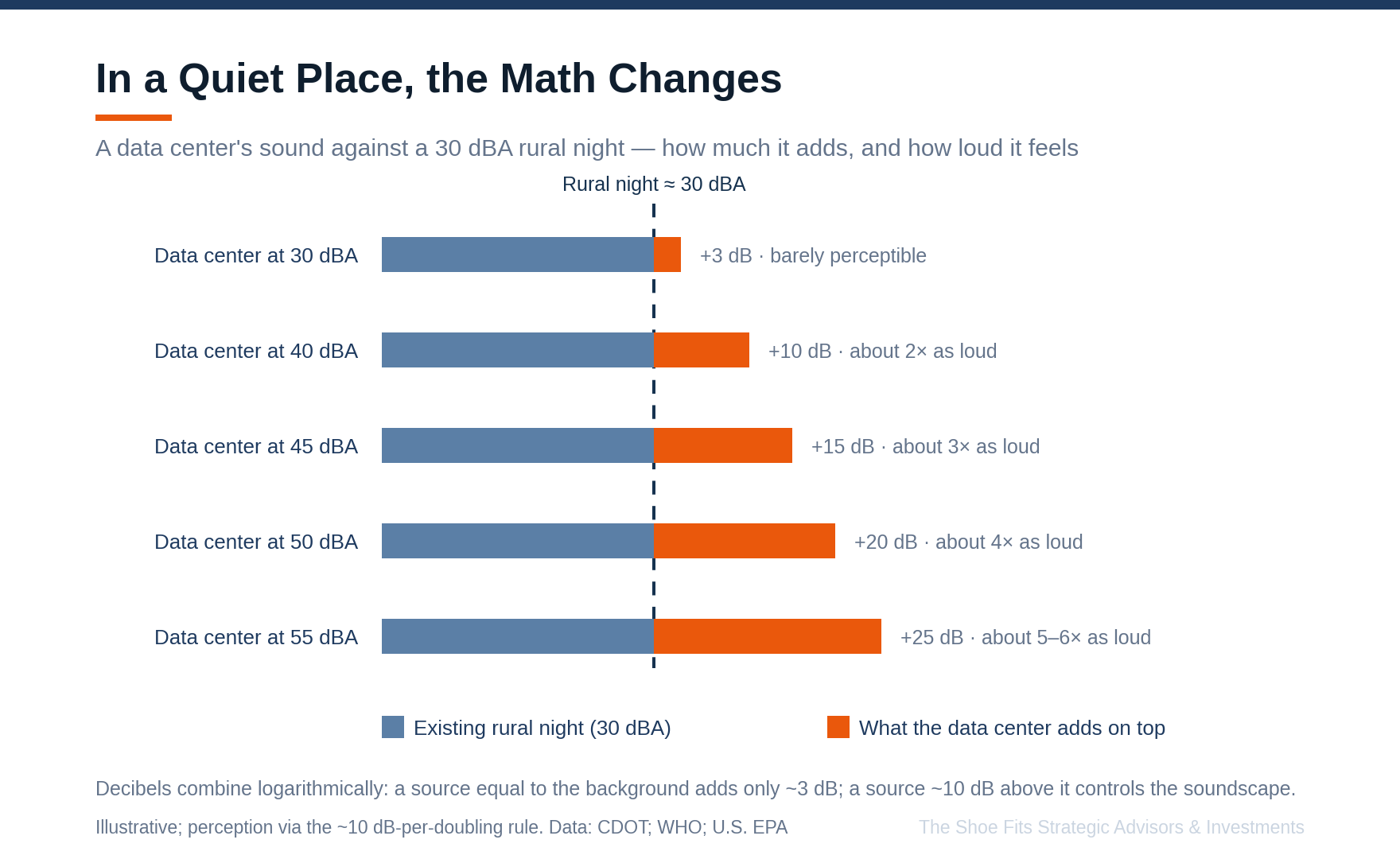
Caption: In a quiet place, the math changes. Because decibels combine logarithmically, a data center only a little above the rural night comes to dominate it — a 50-dBA facility against a 30-dBA background is perceptually about four times as loud as the silence it replaced.
A rural soundscape is not silent, but it breathes. Birds, insects, wind, a distant train, a truck on a farm road, these rise and fall, and some are briefly louder than a data center would be. A data center does not rise and fall. Its fans, chillers, and pumps run around the clock. They can carry a narrow tone that the ear locks onto. They are most exposed at night, when everything else goes quiet. Low-frequency sound also carries over distance and can remain audible indoors, so closing the window is not always an escape. And a continuous mechanical floor can mask the very sounds that the insects, the wind, the water, that make a rural place feel like one.
I want to be careful not to overstate the harm, because overstating it is how credibility is lost. At these exterior levels the concern is generally not hearing loss; the risk of damage is low at or below about 70 decibels, and a data center at a neighboring home sits well under that. The real costs are quieter and more human such as sleep disturbance, annoyance, a porch that is less pleasant in the evening, a window that can no longer be left open at night, and the slow erosion of rural quiet itself. The World Health Organization recommends nighttime levels below 40 decibels outside bedrooms, and under 30 inside, for good-quality sleep. The EPA's protective figures, 55 decibels outdoors and 45 indoors, are long-term averages meant to prevent annoyance, not permission for a continuous source to sit at the limit every hour of every night.
This is why a single property-line number such as 55 dBA, borrowed from a suburban ordinance, may not protect a quiet rural place at all. A standard that fits a place like ours would measure and weigh more than one figure:
The measured pre-development nighttime background, not an assumed one.
Sound at the receiving home, not only at the facility's property line.
A cap on how far the project may raise the level above that existing background.
Both dBA and dBC, so low-frequency tones are actually counted.
Penalties for tonal and narrow-band sound.
Full-load summer operation, generator testing, and simultaneous emergency operation — the loud days, not the quiet hour.
Post-construction and continuing monitoring, so the promise can be checked.
Meta's Richland Parish project, and the new generation Entergy is building to serve it, land in exactly this kind of low-ambient setting — predictable sources, in predictable locations, with predictable neighbors in Rayville, Delhi, and Mangham. That is precisely the situation acoustical modeling handles well, if it is done before the equipment is bought and placed rather than after someone calls to ask what the noise is. Louisiana has the advantage Virginia did not: it can ask for the baseline study, the model, and the commissioning measurement before the first complaint instead of after the fifteenth meeting.
And this is no longer one project in one corner of the state or even one state. The same buildout is arriving on nearly every side of us. Just across the Mississippi River, in Warren County, Amazon Web Services has announced a $3 billion campus at Vicksburg, powered by Entergy Mississippi, with construction slated to begin this year; part of what Mississippi's governor has taken to calling the Digital Delta. About a hundred and fifty miles to the west, in Caddo and Bossier Parishes, Amazon has announced a planned $18 billion buildout of three campuses in the Shreveport area, developed alongside STACK Infrastructure, which announced its own multi-campus development across the same parishes on both sides of the Red River.
Some of these sit in metros, not soybean fields; Shreveport, Bossier City, and Vicksburg are not two-in-the-morning quiet. But the principle does not change at the parish line, or the state line. Some campuses border residential edges of their own, and a family on the outskirts of Shreveport, or across the river near Vicksburg, will hear a continuous mechanical hum the same way a family near Delhi would. To the operators' credit, the Northwest Louisiana package already names the hard parts on water and power; up to $400 million in company-funded public water-infrastructure upgrades at no cost to residents, and a commitment to pay the full cost of new energy infrastructure through SWEPCO. Noise deserves a place on that same list: a measured baseline, a predictive model, and a property-line standard written for the actual neighborhood, before the equipment is placed.
Because in a rural community, the issue is not whether a data center is louder than a concert. It is whether a 24-hour mechanical hum replaces a nighttime soundscape that may have been nearly silent before the facility arrived.
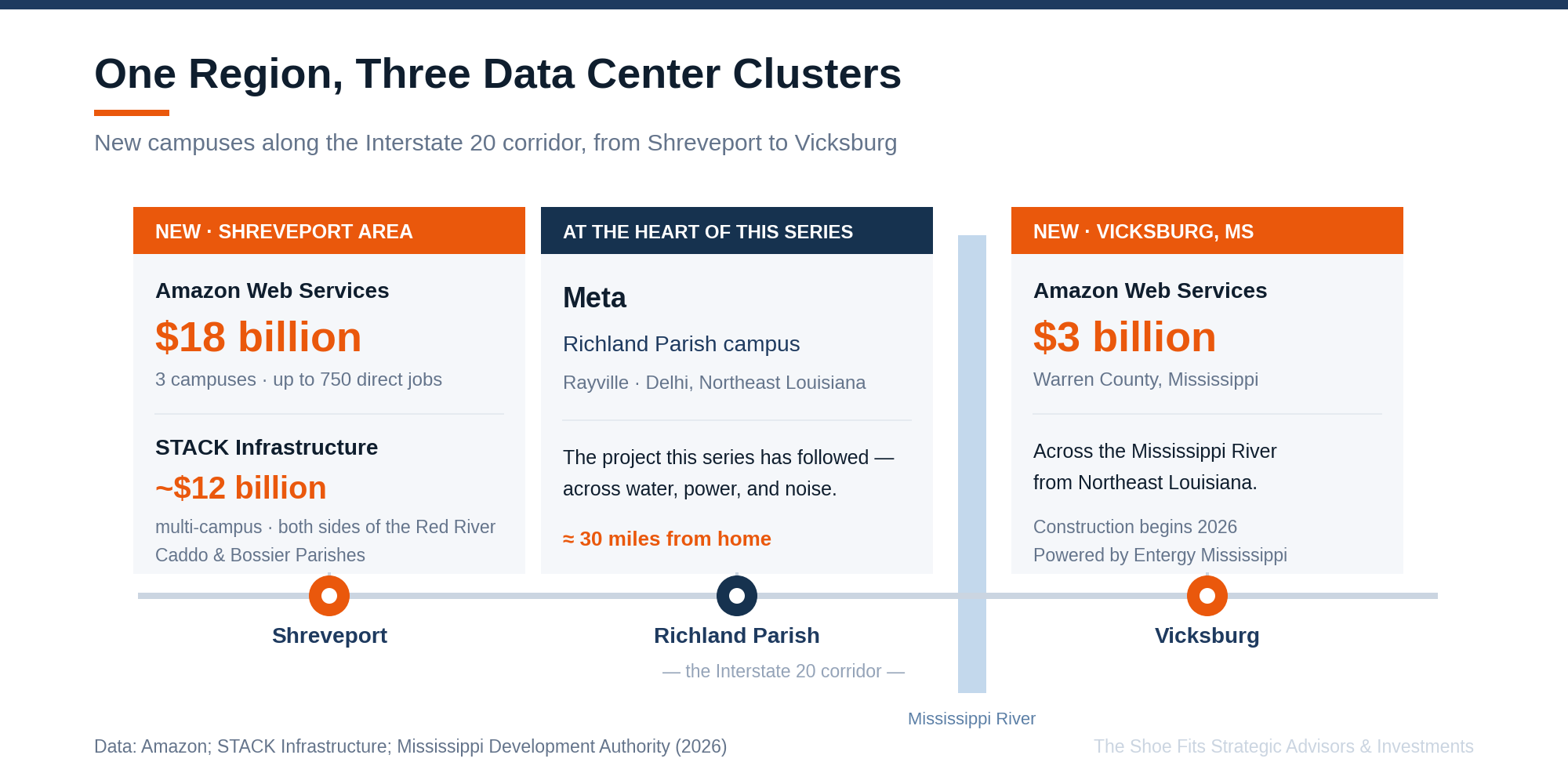
Caption: The data center buildout is not a single headline; it is a corridor. Amazon has announced $18 billion across three Shreveport-area campuses in Caddo and Bossier Parishes — alongside STACK Infrastructure's roughly $12 billion — while a $3 billion Amazon campus rises across the Mississippi River at Vicksburg, and Meta builds in Richland Parish about thirty miles from my door. The investment is real. So are the questions of water, power, and noise that arrive with every one of them.
Engineer It Before You Have to Explain It
Community engagement does not mean every objection can, or should, stop a project. Infrastructure has impacts. Power lines, highways, factories, and data centers all make sound. The goal is not to pretend otherwise. It is to identify the impacts we can reasonably predict, engineer them responsibly, and communicate honestly about what remains.
Noise is the clearest case of all, because so little of it is a mystery. We know what equipment will be installed. We know roughly where it will sit. We know where the neighboring homes are. We have modeling tools, quieter equipment, barriers, enclosures, setbacks, operating controls, and commissioning techniques. Great Oak is the proof of every one of those capabilities. AWS used them, and they worked.
The same engineering that quieted the data center could have been used before the neighbors ever heard it.
So the question is not whether data-center noise can be mitigated. AWS proved that it can. The better question, the one this whole series keeps returning to, is why the community had to hear it first.
Because by the time the first serious noise analysis happens after a complaint, the engineering problem has already become the harder thing to fix: a trust problem. And trust is far more expensive to retrofit than an acoustical barrier.
Because approval matters.
But acceptance matters too.
Connectivity. Strategy. Execution. Value.
Part 4 of 6. Next: Commitments Beat Promises — why communities are done accepting vague assurances, and what a measurable, enforceable commitment actually looks like.
Sources & Further Reading
The Great Oak / Tanner Way case — Prince William County, Virginia
"Amazon Tones Down Its Data Center Noise After Residents Sound the Alarm" — Data Center Knowledge / Piedmont Journalism Foundation (October 24, 2023). The primary account: complaints beginning May 2022 from homes about 600 feet away, resident measurements up to ~65 dBA at night, the delayed engagement and roughly fifteen meetings, the failed acoustic shrouds, and the re-engineering of all 424 rooftop fan/exhaust assemblies for a roughly 10-decibel reduction to about 50 dBA by August 2023. datacenterknowledge.com
Prince William County Data Center Ordinance Advisory Group (2024). The county body that continued to examine Great Oak / Tanner Way and data-center noise analysis in its 2024 work. pwcva.gov
The Warrenton proposal and Northern Virginia policy response
"Frequently Asked Questions on the Data Center in the Town of Warrenton" — Town of Warrenton. The December 2022 denial recommendation citing a lack of information regarding noise, and the final conditions requiring a noise study before each phase's certificate of occupancy, annual studies for the life of the use, and mitigation on exceedance. warrentonva.gov
"Zoning Ordinance Rewrite Change Highlights" — Loudoun County (December 2023). Soundproofing of rooftop and ground-mounted equipment, pre- and post-construction noise studies, generator-testing limits, screening, setbacks, and berm buffers for data centers near residential property. loudoun.gov
"Board of Supervisors Approves New Data Center Zoning Ordinance Amendment" — Fairfax County (September 2024). Residential setbacks, generator separation, and required pre- and post-construction noise studies. fairfaxcounty.gov
"Data Centers in Virginia" — JLARC (December 2024). Finds constant and low-frequency data-center noise can affect nearby residents even within ordinance limits, and recommends authorizing localities to require pre-approval sound modeling and low-frequency-specific limits. jlarc.virginia.gov
Belmont Innovation Campus approvals — Loudoun County (2024). The denial of the larger proposal and approval of a reduced project that retained its buffers and commitments — the "change the project, not the presentation" example. loudoun.gov
Removing noise at the source: cooling technology
"North Texas Community Says Crypto-Mining Facility Brings Never-Ending Noise" — CBS Texas (July 2024), and MARA Granbury sound-mitigation materials. The progression from fans to a sound wall to immersion cooling and third-party acoustic measurement at the Granbury digital-asset facility. cbsnews.com · maragranbury.com
"Simulator-Based Reinforcement Learning for Data Center Cooling Optimization" — Engineering at Meta (September 2024). The AI cooling-control work reporting a ~20% supply-fan energy reduction — presented by Meta as an energy and water initiative, not a noise program; the acoustic implication is this article's inference. engineering.fb.com
How loud is it — sound levels and measurement
"Chantilly Premier Preliminary Sound Modeling Report" — Fairfax County (August 2023). Projects 40–42 dBA at the residential boundary and 52–61 dBA at the commercial boundary during normal full-load operation, plus generator and emergency modeling. fairfaxcounty.gov
"Great Oak / AWS Tanner Way Noise Update" — Prince William County Data Center Ordinance Advisory Group (October 2024). Documents neighborhood readings improving from roughly 58–65 dBA to 48–55 dBA after mitigation. pwcva.gov
"Impact of Noise Inside Server Rooms" — CEUR Workshop Proceedings. Reports average interior data center noise around 70–80 dBA — an interior figure, not a property-line figure. ceur-ws.org
"15 Best Practices for Communities Considering Data Centers" — Loudoun County. Recommends dBA and dBC studies, a 50-dBA property-line limit, tonal-noise mitigation to background, and residential setbacks. loudoun.gov
"Data Center Noise Monitoring" — Larson Davis. Why cooling-fan hum and low-frequency tones can be understated by dBA, and the value of dBC, Z-weighting, and frequency analysis. larsondavis.com
Colorado Department of Transportation — Noise FAQs. Reference levels: freeway at 50 feet 70–80 dBA, conversation 55–65, quiet neighborhoods 45–55, commercial jets 110–120. codot.gov
NIH/NIDCD — Noise-Induced Hearing Loss and CDC/NIOSH — Noise. Conversation, concerts and sporting events (94–110 dBA), and everyday tools for comparison. nidcd.nih.gov · cdc.gov
U.S. EPA — "Environmental Noise Levels Affecting Health and Welfare" and OSHA — Occupational Noise Exposure. The protective long-term averages (55 dBA outdoors, 45 indoors) and the decibel-doubling principle. epa.gov · osha.gov
World Health Organization — night noise and environmental noise guidelines. The recommendation of nighttime levels below 40 dBA outside bedrooms and under 30 dBA inside for good-quality sleep. who.int
Louisiana and the regional buildout
"Amazon to invest $18 billion in Louisiana for new data centers" — Amazon (August 18, 2026). The Northwest Louisiana buildout: three campuses across Caddo and Bossier Parishes (up from a $12 billion announcement in February 2026), up to 750 direct jobs, up to $400 million in company-funded public water-infrastructure upgrades at no cost to residents, and payment of 100% of new energy-infrastructure costs with SWEPCO. aboutamazon.com
"STACK Infrastructure Announces Data Center Developments Supporting Economic Growth in Louisiana" — STACK Infrastructure (February 23, 2026). The multi-campus Caddo/Bossier development on both sides of the Red River, in collaboration with Amazon, with STACK funding water, wastewater, and electrical upgrades. stackinfra.com
"Amazon to build $3bn data center campus in Vicksburg, Mississippi" — Data Center Dynamics; and Governor's announcement, Mississippi Development Authority (2026). The $3 billion Warren County campus across the river from Northeast Louisiana, powered by Entergy Mississippi, with construction slated to begin in 2026. datacenterdynamics.com · mississippi.org
Technical reference
ASHRAE Handbook — HVAC Applications, "Noise and Vibration Control." Outdoor mechanical equipment as a community-noise source; the source-path-receiver framework; blade-pass tones; operating-point and variable-speed effects; and low-frequency prediction uncertainty. ashrae.org
A note on sources: community impacts around data centers are often disputed, and residents, operators, and local governments can read the same project differently. This piece relies where possible on government records, technical publications, company engineering disclosures, and reporting that includes both resident and developer perspectives. Examples are used to examine specific decisions and outcomes, not to label any company or the industry as simply a good or bad community partner.